Construction safety news keeps circling one number. Four construction workers die on the job every day in the US, according to the OSHA Commonly Used Statistics page. Most of that risk sits in four categories: falls, struck-by, caught-in/between, and electrocutions.
That’s why tracking construction safety news isn’t optional reading for a GC. It’s how you catch rule changes, enforcement shifts, and equipment recalls before they land on your jobsite as a citation or a funeral.
Where to actually find reliable construction safety news
Skip the general news aggregators. They’re slow and they miss regional enforcement trends.
Start with OSHA’s news releases page. It posts every regional citation, every national emphasis program, and every proposed rule change the day it happens. Set a weekly reminder to scan it. Five minutes, done.
Your state plan matters more if you work in a state-run OSHA jurisdiction – California, Washington, Michigan, and 20-some others run their own programs with their own deadlines. Cal/OSHA’s heat illness standard, for example, moved faster and stricter than the federal proposal. If you’re bidding work in a state-plan state, bookmark that state’s own agency site. Federal OSHA news doesn’t always apply directly.
Trade associations fill the gap OSHA leaves. The Associated General Contractors of America pushes out safety alerts tied to actual incident data from member firms. Your local AGC chapter often has a safety director who will take your call if you’ve got a question about a new regional enforcement sweep.
Finally, your insurance carrier’s loss control bulletins are underused. They see claims trends six months before OSHA publishes anything. If your EMR carrier sends a bulletin about ladder falls in residential framing, that’s not a coincidence – that’s your actual claims data talking.
Reading an OSHA rule change without a law degree
You don’t need to interpret code language like an attorney. You need to know three things: effective date, who it applies to, and what changes on your site tomorrow.
Take the Table of Contents approach. Most Federal Register notices open with a summary paragraph before the legal language starts. Read that paragraph twice. It’ll tell you the compliance date and the trigger – square footage, trench depth, crew size, whatever threshold matters.
A real example: when OSHA updated its respirable crystalline silica standard, the trigger wasn’t abstract. It was a permissible exposure limit tied to specific tasks – tuckpointing, dry cutting block, grinding concrete. If your scope included none of those tasks, the rule barely touched you. If it did, you needed exposure control methods or a written exposure control plan within the compliance window.
When a rule touches structural load paths, means and methods on shoring, or anything that could shift liability onto your stamped drawings, that’s not a safety-news reading exercise anymore. Bring in the engineer of record or a construction attorney before you change anything in the field. Reading the news tells you something changed. It doesn’t tell you how your specific trench box, your specific shoring plan, or your specific scaffold tag complies.
Tracking construction safety news and enforcement trends by region
OSHA runs Regional and National Emphasis Programs that concentrate inspectors on specific hazards for a set period. Knowing which NEP is active in your region changes how you prep for a surprise walk-through.
The Trenching and Excavation NEP has been a recurring one for years, and it’s not going away – trench collapses still kill workers every season, often on small utility and site-work jobs where nobody called for a trench box because “it’s only going in for an hour.”
Here’s the field reality: inspectors under an active NEP aren’t waiting for a complaint. They’re driving by open trenches and stopping. If your crew is in a trench deeper than 5 feet without protective systems, or deeper than 4 feet without a means of egress every 25 feet of lateral travel, that’s a walk-through waiting to happen, NEP or not.
Check your OSHA region’s inspection data on the OSHA enforcement data page periodically. It’s public. You can see which NAICS codes and which hazard types got hit hardest in your area over the last reporting period. That tells you where to tighten your own toolbox talks before an inspector tells you for you.
Equipment recalls and manufacturer safety bulletins
Recalls move fast and get buried. A crane manufacturer issues a service bulletin, it hits trade press for a week, then disappears – meanwhile your rental fleet still has three units with the flagged part.
Register your equipment serial numbers directly with manufacturers when you buy or lease. Caterpillar, John Deere, and most crane OEMs run registration portals specifically so recall notices reach the actual equipment owner, not just the original dealer.
The Consumer Product Safety Commission recalls database covers some construction tools and PPE, but heavy equipment recalls usually route through the Department of Transportation’s National Highway Traffic Safety Administration for anything road-registered, or directly through OEM service bulletins for yellow iron.
A fall protection example worth remembering: harness and lanyard recalls happen more often than crews assume, usually tied to a stitching defect or a buckle failure identified after an incident report. If your safety officer isn’t checking manufacturer bulletins quarterly, you’re trusting that nobody on your crew is wearing a recalled harness. That’s a bad bet on a 30-story job.
Weather and climate-driven rule changes
Heat illness rules are the biggest moving target in construction safety right now. Federal OSHA proposed a national heat standard, but it’s moving through rulemaking slowly, and several states didn’t wait.
California’s heat illness prevention standard requires water, shade, and cool-down breaks once temperatures hit specific thresholds, with stricter requirements above 95°F. Washington and Oregon run similar triggers. If you’re a GC working across state lines, you can’t run one heat policy for every job – you need to know which state standard applies to which site, because the thresholds and paperwork requirements aren’t identical.
Cold weather doesn’t get the same regulatory attention, but it should get the same jobsite attention. Frostbite and hypothermia incidents spike on exterior concrete pours and steel erection jobs in freezing conditions, and OSHA’s General Duty Clause still applies even without a cold-specific standard.
Track NOAA weather alerts for your region alongside safety news. A heat advisory or a cold snap warning should trigger your written heat/cold plan automatically, not get discovered by a foreman checking his phone at 10 a.m.
Staying current on construction safety news without drowning in it
You don’t need to read everything. You need a short, repeatable list you actually check.
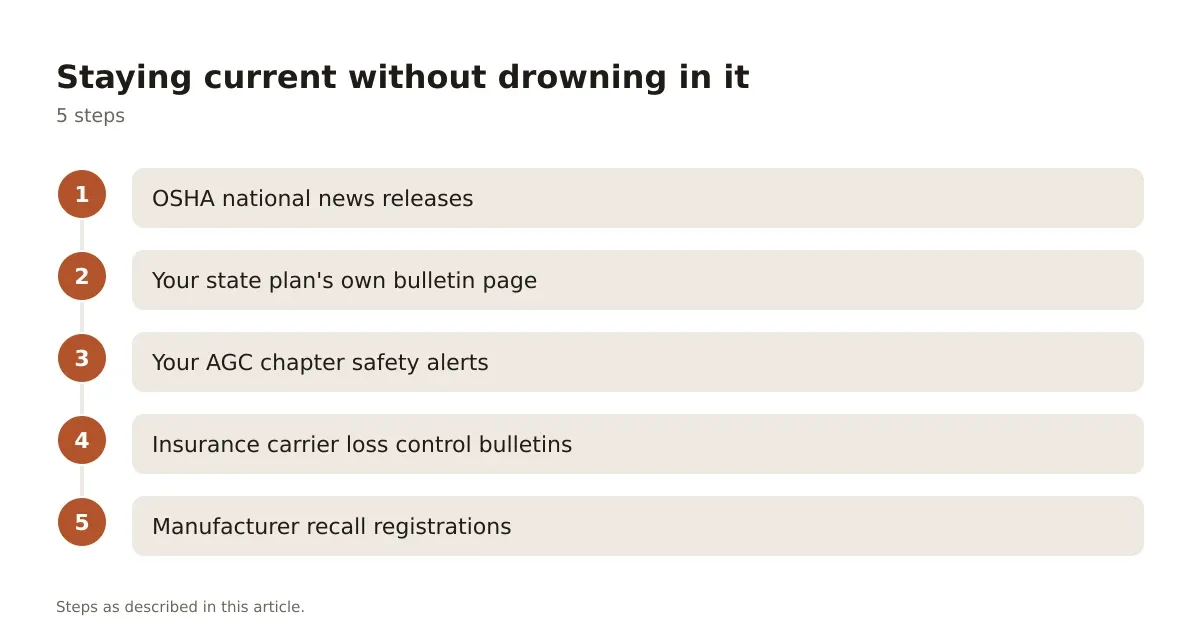
- OSHA national news releases – weekly scan, five minutes, catches citations and rule proposals.
- Your state plan’s own bulletin page – monthly check if you work in a state-run OSHA jurisdiction.
- Your AGC chapter safety alerts – usually emailed, read them when they land.
- Insurance carrier loss control bulletins – these reflect real claims data, not just regulatory activity.
- Manufacturer recall registrations – set up once per major equipment purchase, then it’s passive.
Assign this to one person on your team – a safety director if you have one, a senior PM if you don’t. Rotating the task among whoever’s free that week guarantees it gets skipped during a busy bid season, which is exactly when a missed update costs you. For a broader view of how these pieces fit into a full program, a lot of GCs build their weekly scan into the same routine covered in construction safety management programs that actually hold up under inspection.
Turning construction safety news into toolbox talks
None of this matters if it stays in somebody’s inbox. The gap between “safety director read the bulletin” and “crew foreman changed Monday’s talk” is where most programs fail.

Build a two-step habit. First, whoever reads the news writes one sentence: what changed, who it affects, what to do differently. Second, that sentence goes into the next toolbox talk within a week, not whenever someone gets around to it.
A real pattern: when a regional NEP targets trenching, the toolbox talk that week shouldn’t be a generic “be careful near excavations” script. It should say exactly what inspectors are checking – protective system in place over 5 feet, spoil pile set back 2 feet minimum, ladder or ramp within 25 feet of workers. Specific beats generic every time a crew actually listens.
If you want a library of talks already built around current hazard categories instead of starting from scratch each week, there are toolbox talk banks organized by trade and hazard – construction safety topics broken down that way save a lot of Monday-morning scrambling.
Keeping the habit alive past the first busy season
Safety news tracking dies the same way most good habits die on a jobsite: it works great until bid season gets heavy, then it quietly stops. The firms that stick with it treat the weekly scan like payroll – it happens whether you feel like it or not.
Pair it with your existing PM software if you can. Some scheduling platforms let you drop a recurring task into the same board where you track permits and inspections, so the safety scan sits next to deadlines you’re already watching. It’s a small move, but putting it where you already look beats a separate system nobody opens.
The bigger point: construction safety news isn’t trivia. It’s early warning. A rule change you catch in week one costs you an update to your written program. The same rule change you miss until an inspector cites you costs a penalty, a stop-work order, and sometimes a worker’s life. Pick the cheaper option.
Frequently asked questions
How often should I check construction safety news?
Weekly is the minimum for OSHA’s national releases, monthly for your state plan if you’re in a state-run jurisdiction. Daily checks are overkill unless you’re running a high-hazard operation like trenching or crane work during an active emphasis program in your region.
Do I need to follow federal OSHA news if I work in a state-plan state?
Yes, but your state’s own standard usually takes priority when it’s stricter, which it often is in states like California and Washington. Federal updates still matter because state plans typically have to match or exceed federal minimums within a set adoption window.
What’s the fastest way to know if a new rule applies to my current job?
Check the trigger conditions in the rule summary, not the full legal text, things like exposure limits, trench depth, or crew size thresholds. If your scope of work matches a trigger, read further or call your AGC chapter safety director; if it doesn’t apply to your scope, you can usually move on.
Who should actually be reading this news on my team?
One designated person, usually a safety director or senior PM, not a rotating assignment. Rotating it among whoever’s available guarantees it gets dropped during busy stretches, which is exactly when missing an update costs the most.
Can I rely on trade publications instead of OSHA’s own site?
Trade publications are fine for context and interpretation, but always confirm against OSHA’s own release or your state agency’s bulletin before changing anything on-site. When a rule change affects engineering, shoring design, or anything touching your stamped drawings, loop in the engineer of record or a construction attorney rather than relying on any news summary alone.