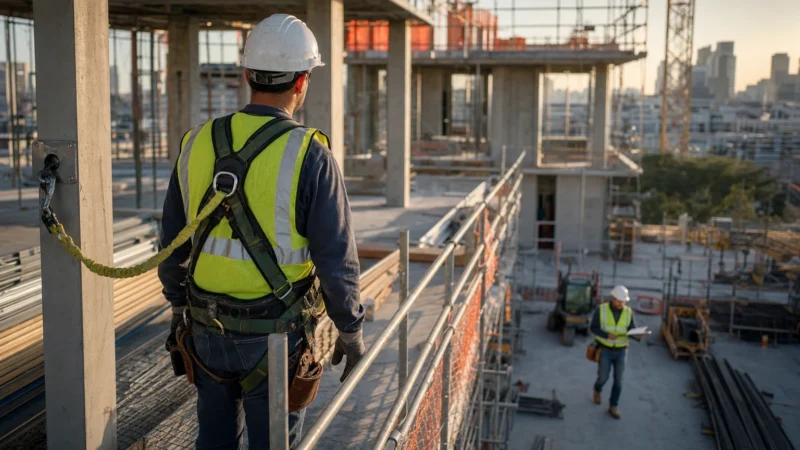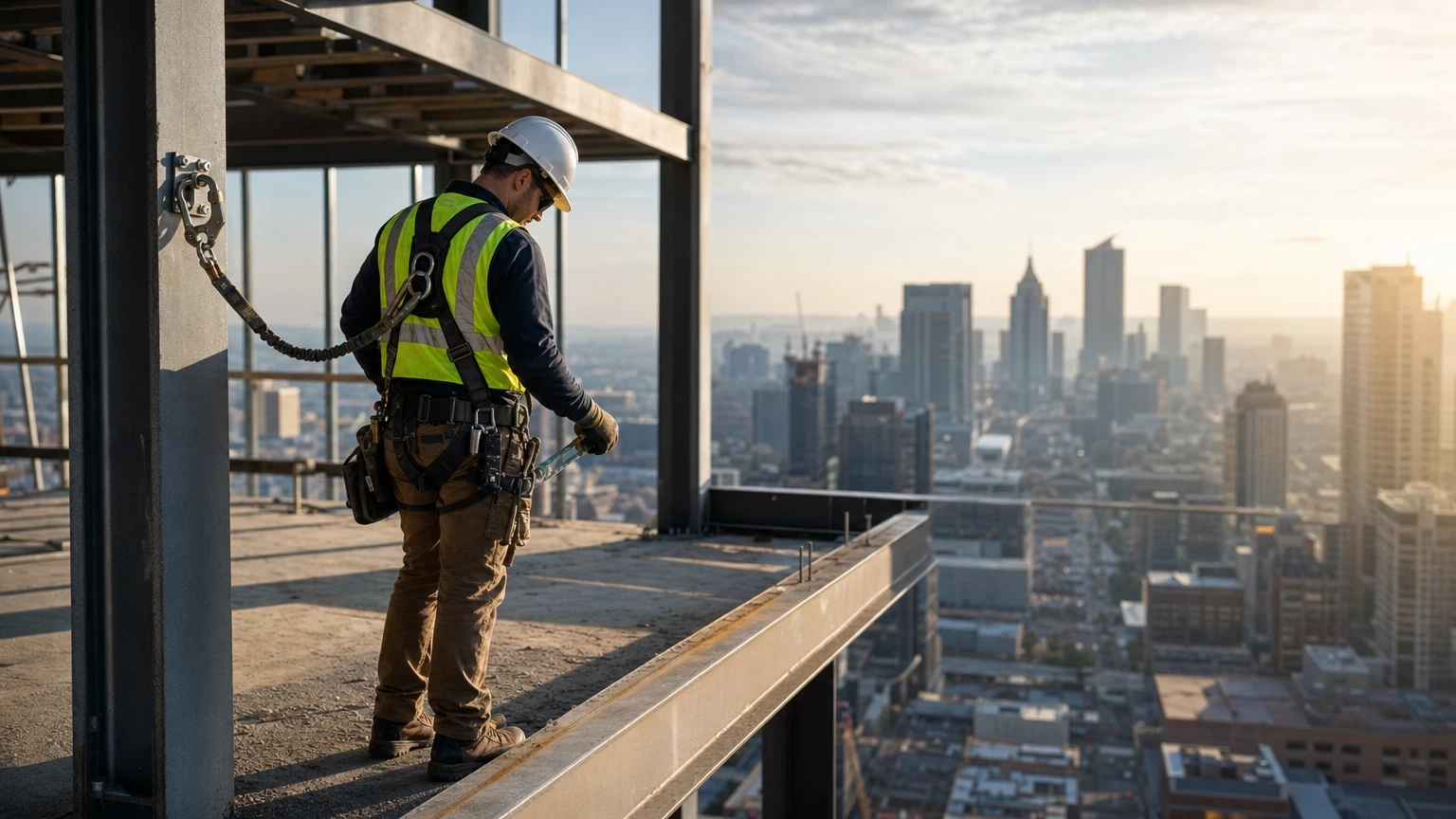
Your super calls Friday afternoon. OSHA showed up unannounced on the framing crew and found two guys tied off wrong on a 22-foot parapet. Now you’re looking at a citation that could run $16,550 per serious violation under 2026 penalty levels. Those OSHA maximums took effect 15 January 2025 and are unchanged for 2026. This is exactly what construction safety management exists to prevent.
That’s the moment most GCs realize their safety program is a binder nobody reads. Construction safety management isn’t paperwork you produce after an incident. It’s the daily system that decides whether your crew goes home the same way they showed up.
Why Construction Safety Management Fails on Active Jobsites
A 40-page safety plan that lives in a truck glovebox is a compliance document, not a safety program. Nobody opens it after the pre-con meeting, and nothing in it changes what happens on the deck at 7 a.m.
The problem wasn’t the content. It was that the plan existed separately from the schedule. Your foreman doesn’t need a policy manual at 6:45 a.m. He needs to know that the scissor lift inspection is due today and the fall protection anchor points on level 4 haven’t been rated yet.
Programs fail when the paperwork and the fieldwork run on different tracks. A safety plan that isn’t tied to your look-ahead schedule gets ignored by week three. OSHA-required hazard communication sheets routinely end up posted in a trailer that no laborer ever walks into.
The fix is boring but it works: fold safety checks into the same daily huddle where you review manpower and material deliveries. Five minutes, same time, every day. On a 60-person job, that’s cheaper than one recordable incident, which averages $42,000 in direct costs according to OSHA data on non-fatal injuries.
Building a Construction Safety Management Plan That Gets Used
Generic templates from your insurance broker are a starting point, not a finished product. Every site-specific plan needs to reflect the actual hazards on that lot, not the hazards on the last one.
On a tilt-up warehouse in a hot, dry market, the biggest exposure usually isn’t falls, it’s heat. Take ambient temps at 108°F in July with 30 laborers pouring slab: a plan full of rain and mold language does nothing for that crew. Heat illness prevention, shade, water, and a fixed work/rest cycle belong in the plan before anyone breaks ground.
A workable site-specific plan runs 8 to 12 pages, not 60. It names the top five hazards for that job: crane picks, trenching, hot work, elevated work and traffic control. It assigns a competent person by name for each. It also lists the emergency contact and nearest trauma center with drive time. Attach it to the permit package the AHJ (authority having jurisdiction) reviews. More jurisdictions in 2026 are asking for safety documentation alongside the building permit submittal. That applies especially to projects over 75 feet or with tower cranes.
Update it every time scope changes materially. Adding a basement level or bringing on a steel erection sub mid-project means new hazards, which means a plan revision, not a mental note.
Toolbox Talks and Daily Documentation That Hold Up
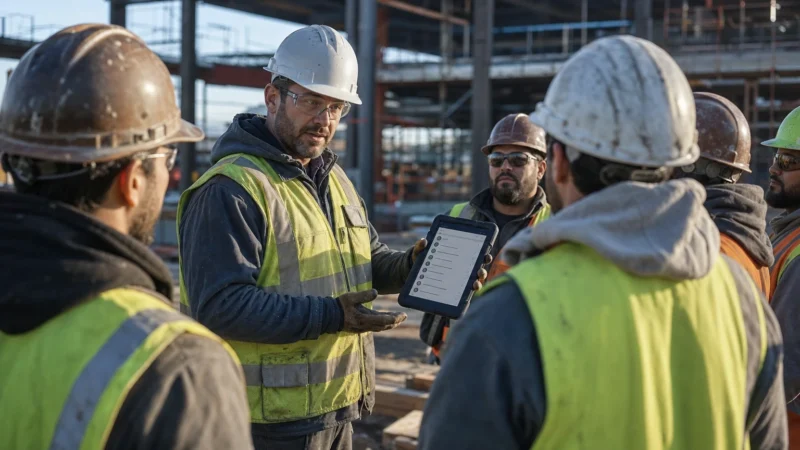
Toolbox talks get treated like a box to check. They shouldn’t be.
A five-minute talk on ladder placement, delivered right before three guys start hanging drywall on stepladders, changes behavior that morning. A talk pulled from a generic PDF library, read in a monotone, changes nothing.
Here’s what actually holds up if OSHA or your insurance auditor asks for records six months later:
- Date, time, and jobsite location on every talk sheet
- Topic tied to that week’s actual work (not a random rotation)
- Names and signatures of every attendee, legible
- Photo of the crew at the talk, timestamped
- Any hazard identified during the talk logged separately with a corrective action and a close-out date
Digital tools like Procore or Raken let your foreman knock this out in under 90 seconds per talk on a phone. Paper works too, but paper logs have a way of disappearing right when a claims adjuster wants them. Digital timestamps don’t disappear.
Keep records for at least three years. Some states, California among them, expect longer retention on projects involving Cal/OSHA-regulated high-hazard work like trenching over 5 feet or scaffolding above 10 feet.
Subcontractor Safety Compliance and Insurance Verification
Your GL policy doesn’t cover a sub’s crew if that sub shows up with an expired workers’ comp certificate. That’s a $2 million exposure sitting on your desk unnoticed.
Before any sub sets foot on site, you need current certs. General liability is typically $1 million per occurrence and $2 million aggregate on commercial work. Workers’ comp runs to state statutory limits. An umbrella policy is often required too, commonly $5 million on projects over $10 million in value.
Consider a mechanical sub whose comp certificate lapses for 11 days between renewal cycles and nobody catches it. Any injury that lands inside that window has no carrier standing behind it. A gap that small can turn a routine claim into a six-month argument between your attorney and theirs over who absorbs the loss.
Run compliance through a tracking platform, not a spreadsheet someone forgets to update. Track expiration dates 30 days out and require automatic re-verification before badge access or gate check-in on controlled sites. On union jobs, also confirm the sub’s OSHA 10 or OSHA 30 training compliance for supervisory staff, since many project labor agreements now mandate it as a condition of mobilization.
If a sub’s certificate lapses mid-project, pull them off site until it’s cured. No exceptions, no “we’ll get it Monday.”
Comparing Safety Management Software for General Contractors
If you are weighing a broader jobsite platform at the same time, see our guide to the best construction project management software.
Picking the right platform matters more than picking the cheapest one. Here’s how the major players stack up for a GC running multiple active sites.
| Platform | Best for | Approx. pricing (2026) | Weak spot |
|---|---|---|---|
| Procore | Mid-to-large GCs needing full project + safety integration | Custom, typically $667+/mo per project bundle | Steep learning curve for small crews; overkill under $2M jobs |
| SafetyCulture (iAuditor) | Digital inspections and toolbox talks | Free tier; paid plans from $24/user/month | Weak scheduling and payroll integration |
| Raken | Daily reports plus safety logs in one app | From $15/user/month | Limited incident investigation workflow |
| HammerTech | Site access control and induction tracking | Custom quote, mid-market pricing | Steeper setup time, best for larger GCs with dedicated admin |
If you’re running under five active sites and want simple toolbox talk logging, SafetyCulture gets it done without the overhead. If you need safety tied to scheduling, submittals, and RFIs in one ecosystem, Procore is the heavier but more complete option. Neither replaces a competent person walking the site daily. Software documents what happens; it doesn’t stop the fall.
Fall Protection, Trenching, and the Hazards That Trigger Willful Citations
Three hazard categories generate the majority of serious citations on commercial jobs: falls, trenching/excavation, and struck-by incidents from mobile equipment.
Falls remain OSHA’s most-cited standard nationally, year after year. Anything over 6 feet in construction requires fall protection under 1926.501, guardrails, safety nets, or a personal fall arrest system properly anchored to a point rated for 5,000 pounds per worker.
Trenching is where the ugliest outcomes happen. Any excavation 5 feet deep or greater needs a protective system, sloping, shoring, or a trench box, unless a competent person determines the soil type allows otherwise and documents it. A sub who skips the trench box for “just a quick tie-in” on a 6-foot trench is the most common way this goes wrong. At that depth an unprotected wall can fail with no warning and bury a worker before anyone reaches the edge. Skipping protection a competent person already called for is the kind of decision OSHA treats as willful, and willful violations in 2026 can run over $165,514 per instance.
Struck-by hazards from backing equipment, forklifts, and swinging crane loads round out the top three. Spotters, backup alarms, and exclusion zones around crane picks aren’t optional line items, they’re what keeps your incident rate under your target EMR (experience modification rate). An EMR above 1.0 means you’re paying more for workers’ comp than your industry baseline, and it follows you into every bid.
None of this replaces a licensed engineer’s sign-off on shoring design for deep excavations, or a structural engineer’s review of temporary bracing on a partial demo. If the geotechnical conditions look unusual, or the AHJ flags something during inspection, bring in the engineer of record. Don’t guess.
Incident Investigation and OSHA Recordkeeping Requirements
When something does happen, how you document it in the first 24 hours determines your exposure for the next two years.
OSHA’s 300 log requires recording any work-related injury involving days away from work, restricted duty, or medical treatment beyond first aid. Fatalities must be reported within 8 hours; hospitalizations, amputations, or loss of an eye within 24 hours, straight to OSHA, not just your insurance carrier.
Take a hand caught in a material lift. The order is medical care first, then evidence. Get the injured worker to urgent care inside the hour. Photograph the equipment before anyone touches or resets it. Then pull the maintenance and inspection log the same day. Documentation gathered that fast is often what keeps a citation at a general violation instead of a serious one. It lets you show the machine had passed inspection days before the incident. Wait a week and the photos, the log, and the witness statements are all weaker.
Your investigation should happen within 24 to 48 hours while memories are fresh. Interview witnesses separately. Preserve the scene if it’s safe to do so. Don’t let anyone move equipment “to clean up” before photos are taken.
Bring in a construction attorney early if there’s any chance of a third-party claim or a citation contest. Don’t let your safety director negotiate directly with OSHA’s area office without legal counsel present, especially if a willful or repeat classification is on the table.
Construction Safety Management as Part of the Job, Not On Top of It
Construction safety management works when it’s built into the schedule, the sub contracts, and the daily huddle, not bolted on as a compliance afterthought.
The GCs who keep their EMR under 0.9 and avoid the six-figure willful citations aren’t running fancier programs. They’re running the same five or six habits, consistently, on every job: site-specific plans, documented toolbox talks, verified sub insurance, fast incident response, and hazard-specific controls for falls, trenching, and struck-by risk.
Get those right and the paperwork basically writes itself when an auditor or adjuster comes asking.
None of this works as a separate programme. Construction safety management earns its keep when it is folded into the daily build sequence, so the plan, the toolbox talk and the inspection all reference the same scope of work.
If you are starting from a binder nobody opens, pick one trade and one hazard and run construction safety management properly there for a month. A narrow system that crews actually follow beats a complete construction safety management manual that sits on a shelf.
Treated this way, construction safety management stops being an overhead line and becomes a scheduling input. That is the whole argument for construction safety management as a build discipline rather than a compliance exercise.
Put simply, construction safety management is a planning habit, not a binder.
Frequently asked questions
What’s the difference between a safety plan and a safety program?
A safety program is your company-wide policy, covering training standards, PPE requirements, and general procedures across all jobs. A site-specific safety plan applies that program to one project’s actual hazards, crew size, and site conditions. You need both, but the plan is what gets used daily on the ground.
How much does poor construction safety management actually cost a GC?
Direct costs for a recordable injury average around $42,000 including medical and admin time, per OSHA estimates. Add EMR increases that raise your workers’ comp premiums for three years, plus lost bid competitiveness since many public owners require EMR under 1.0 to even qualify.
Do you need a full-time safety manager on every job?
Not always. Projects under roughly $5 million with straightforward scope can often run with a trained competent person, usually the super, handling daily safety duties. Larger jobs, especially those with multiple subs, crane work, or trenching over 5 feet, generally justify a dedicated safety coordinator.
How often should toolbox talks happen?
Weekly at minimum, daily on higher-hazard phases like steel erection, excavation, or roofing. Match the topic to that week’s actual scope rather than rotating through a generic list unrelated to the work happening.
When should you bring in an attorney instead of handling an OSHA citation internally?
Bring in a construction attorney immediately if you receive a willful or repeat classification, if there’s a fatality or hospitalization involved, or if you’re considering contesting a citation. The informal conference window with OSHA’s area office is short, usually 15 working days, so don’t wait to make the call.