Think a binder full of toolbox talks keeps you compliant? It doesn’t. Construction site safety gets judged by what OSHA sees on the ground, not what’s printed in your office.
Superintendents who pass surprise inspections share one habit: they walk the site like a compliance officer every single morning, before coffee gets cold. This construction site safety guide covers what that walk actually looks for, and where most GCs get caught short.
Why Paper Programs Fail on Active Jobs
A construction site safety manual sitting in the trailer means nothing if the crew on the fourth floor isn’t tied off. OSHA inspectors don’t ask for your written program first. They walk the site.
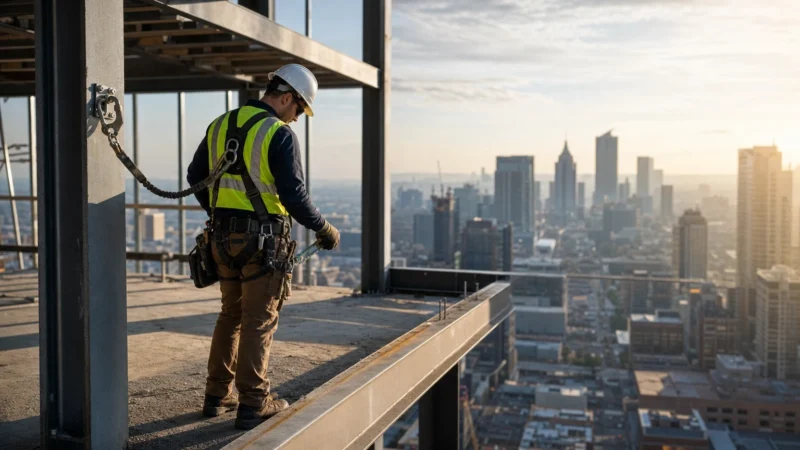
Fall protection above 6 feet in construction gets cited constantly, and it’s rarely because contractors don’t own harnesses. It’s because a guy ran out to grab rebar and skipped clipping in for “just a minute.” That minute is what gets photographed.
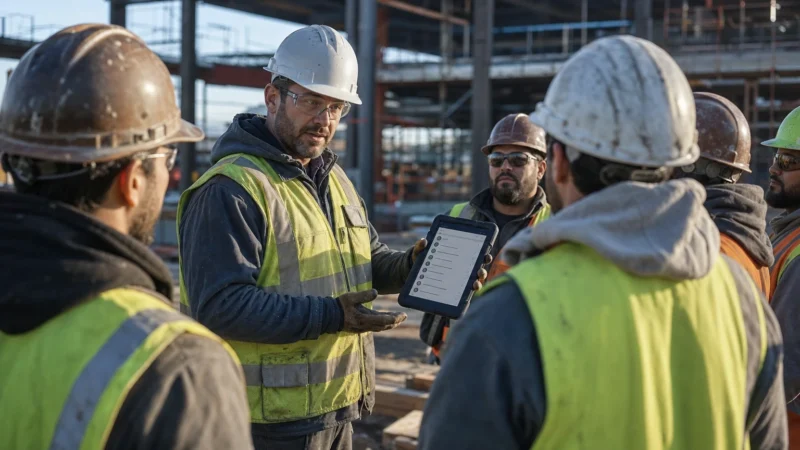
The fix isn’t more paperwork. It’s daily verification. Superintendents who run tight sites do a physical walk before 7 a.m., checking guardrails, trench boxes, and ladder tie-offs against what’s written down. If the walk doesn’t happen, the construction site safety program is decorative.
Retainage and change orders get argued over documentation constantly. Safety violations work the same way. If you didn’t log it, didn’t photograph it, and didn’t correct it same-day, you have no defense when the citation lands.
The Trench Box Nobody Wants to Rent
Excavation collapses kill faster than almost any other jobsite hazard. A cubic yard of soil weighs around 3,000 pounds, and a trench wall doesn’t warn you before it lets go.
OSHA’s excavation standard requires protective systems for trenches 5 feet deep or greater, unless the excavation is entirely in stable rock. Sloping, benching, shoring, or a trench box, one of those has to be in place. Contractors skip this constantly on short-duration digs, the “we’ll be in and out in twenty minutes” utility tie-ins that turn into two hours.
A trench box rental runs a few hundred dollars a day depending on region and size class, cheap against a fatality investigation and a shutdown that can freeze a job for weeks. Crews that skip the box because the rental yard is thirty minutes out are gambling the whole schedule on soil that hasn’t moved yet.
Spoil piles matter too. Keep excavated material back at least 2 feet from the trench edge. Surcharge loading from a spoil pile stacked too close is how “stable” trenches fail without warning.
Fall Protection: Guardrail Systems vs Personal Fall Arrest
Every framing and structural job hits this decision point. Which system actually fits your sequence, and which one slows the crew down enough that they’ll cheat it?
Option A: Guardrail Systems
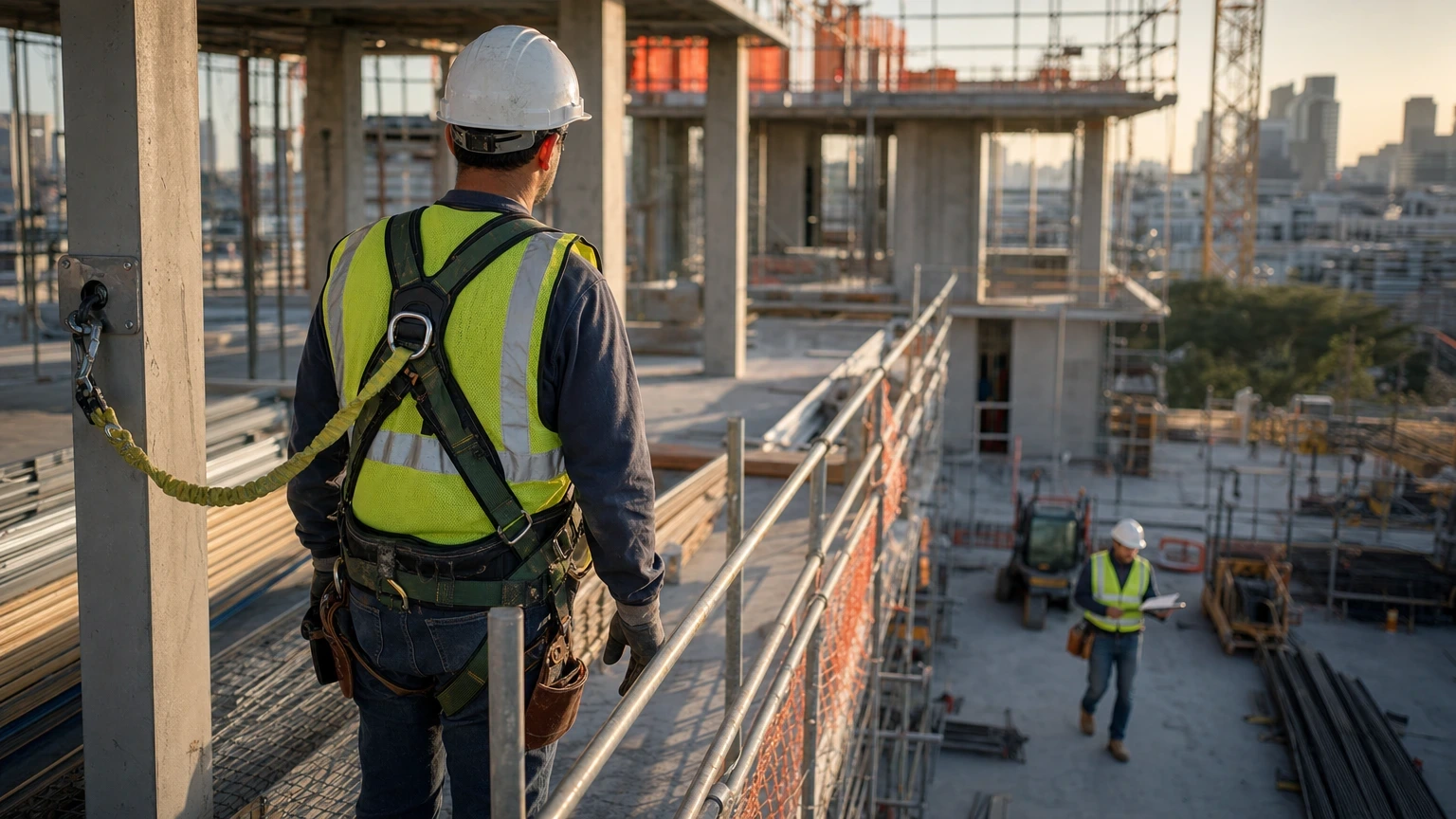
Guardrails are passive protection. Once installed, workers don’t have to do anything to stay protected, no clipping in, no inspecting a harness before shift.
Top rail at 42 inches, mid-rail at 21 inches, and the system needs to withstand 200 pounds of outward force per OSHA’s standard. Good for perimeter edges, floor openings, and roof edges on low-slope work.
Where guardrails fall short: they’re slow to build and slower to move. On a multi-story frame where the leading edge shifts daily, rebuilding guardrail every day eats labor hours you don’t have budgeted. They also don’t work for vertical rebar penetrations or small floor openings where a rail system is impractical.
Option B: Personal Fall Arrest Systems
A PFAS, harness, lanyard, anchor point, works anywhere a guardrail can’t reach. It’s the only option for steel erection, leading-edge work, and most bridge and structural jobs.
The catch is compliance depends entirely on the worker. A harness with a frayed D-ring or a lanyard clipped to an unrated anchor is worse than nothing, it gives false confidence. Anchor points need a rated capacity of 5,000 pounds per worker attached, unless engineered by a qualified person for a lower load with a safety factor of two.
Inspect harnesses before every shift. Stitching, D-rings, webbing for UV wear, all of it. A harness that’s been left in a truck bed through a full summer is a harness that’s failing from sun exposure you can’t see yet.
Most GCs run both systems on the same job. Guardrail where it’s static, PFAS where the work moves. Pretending one system covers everything is how gaps open up.
Five Citations That Show Up on Almost Every GC’s Record
OSHA publishes its most-cited standards every year, and construction’s list barely changes. Here are the five violations that keep landing on general contractors regardless of project size:
- Fall protection – general requirements. Missing guardrails, unprotected roof edges, workers on ladders above 6 feet with no tie-off.
- Hazard communication. Missing safety data sheets, unlabeled containers, no written HazCom program on site.
- Scaffolding. No guardrails on platforms above 10 feet, planking that doesn’t meet the 18-inch minimum width, missing access ladders.
- Ladders. Damaged rungs still in use, ladders extended less than 3 feet above the landing surface, improper angle setup.
- Eye and face protection. Grinding and cutting without rated safety glasses or face shields, a violation inspectors catch in about five seconds of watching a saw run.
Every one of these is cheap to fix and expensive to ignore. A $40 face shield costs nothing next to a willful citation, and willful citations under OSHA’s penalty structure run into serious money per violation, adjusted annually for inflation.
What Your Pre-Task Plan Should Actually Cover
A pre-task plan, sometimes called a JHA or job hazard analysis, only works if the foreman filling it out actually looks at the task instead of copying yesterday’s form. Most sites fail here first.
The plan needs to name the specific task, not “framing” but “framing second-floor exterior wall, north elevation.” It needs the hazards unique to that task that day, weather, adjacent trades, overhead work happening above the crew. And it needs a name attached, the foreman who verified the crew reviewed it before work started.
Superintendents who run this well tie the pre-task plan to the daily log. If the plan says fall protection required and the daily log photo shows nobody tied off, that’s a documentation contradiction that makes your whole safety program look staged during a claim or an OSHA records request.
Keep it to one page. A five-page JHA nobody reads is worse than a one-page form the crew actually fills out at the gang box every morning.
Coordinating Construction Site Safety Across Multiple Subcontractors
Multi-employer worksites are where responsibility gets murky fast. OSHA’s multi-employer citation policy holds the general contractor accountable as the controlling employer, even for hazards created by a sub’s crew.
That means your safety program can’t just cover your own employees. If the electrical sub’s guy is working an unguarded floor opening, that’s your citation too, because you had the authority to correct it and didn’t.
Run a pre-construction safety meeting with every sub before mobilization, not just a signature on a subcontract clause. Set the expectation that any sub creating a hazard gets stop-worked until it’s fixed, no exceptions for schedule pressure. Document who attended and what was covered.
Weekly coordination meetings should include a safety agenda item every time, not just schedule and RFIs. Ask each sub foreman directly what hazards their crew is creating that week. Most will tell you honestly if you ask before an inspector does.
Building a Construction Site Safety Program That Survives an Actual Inspection
Construction site safety isn’t a binder, it’s a daily discipline that shows up in what the crew does when nobody official is watching. The GCs who pass inspections consistently aren’t the ones with the thickest program. They’re the ones who walk the site every morning and correct problems before lunch.
Budget for construction site safety like you budget for general conditions. Trench boxes, harness replacement, PPE restocking, none of it is optional overhead you trim when a bid gets tight. It’s baseline cost of doing business on an active jobsite.
You may be unsure whether a specific condition meets code. Perhaps a shoring design’s adequacy for your soil class is in doubt, or a citation seems worth contesting. That’s the moment to call a licensed engineer, your AHJ, or a construction attorney. Guessing on a safety call is how a manageable problem becomes a fatality investigation.
Daily walks only work inside a larger system, which is why construction site safety and a documented construction safety management program have to be built together rather than bolted on after the first citation arrives.
Frequently asked questions
What is the OSHA fall protection height requirement for construction?
Fall protection is required at 6 feet in construction, compared to 4 feet in general industry. That applies to unprotected sides, edges, floor openings, and most ladder and scaffold work above that height. Check OSHA’s fall protection standard for the specific subpart that applies to your trade.
How often should a construction site safety walk happen?
Daily, before the crew starts work, not once a week. A five-minute walk catching an unguarded opening or a missing trench box beats a two-hour investigation after someone gets hurt. Superintendents who skip this on busy weeks are the ones who get caught by surprise inspections.
Who is responsible for safety on a multi-employer construction site?
The general contractor, as controlling employer, carries responsibility for hazards across the whole site, not just its own crews. OSHA’s multi-employer citation policy allows citations against the GC even when a subcontractor’s employee created the hazard. That’s why pre-construction safety meetings with every sub matter.
What does a trench box rental typically include?
A standard trench box rental includes the shoring panels and spreaders sized to your trench depth and soil classification, delivered and picked up by the rental yard. Pricing varies by region and box size class, so check with your local shoring supplier for current rates. You still need a competent person on site to classify the soil and confirm the box fits the excavation.
How do I know if my safety program will hold up during an OSHA inspection?
If your daily logs, pre-task plans, and photos match what the inspector actually sees on the walk, your program holds up. Gaps between paperwork and jobsite reality are what turn a routine inspection into a serious citation. When you’re unsure about a specific code requirement or shoring design, bring in a licensed engineer or your AHJ before the inspector does it for you.