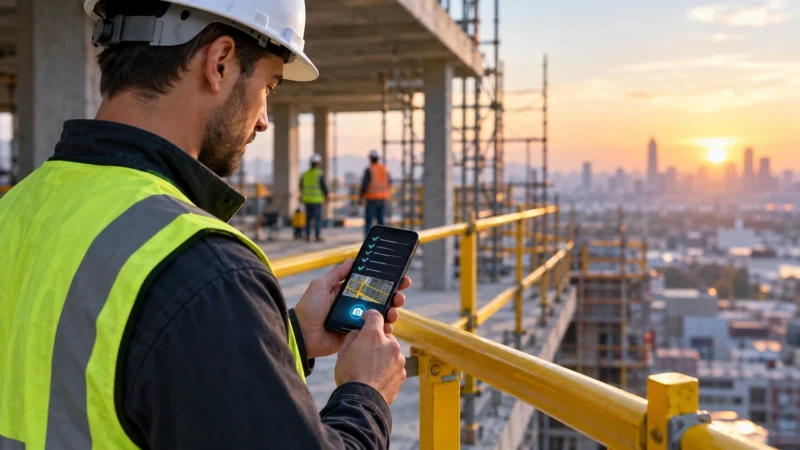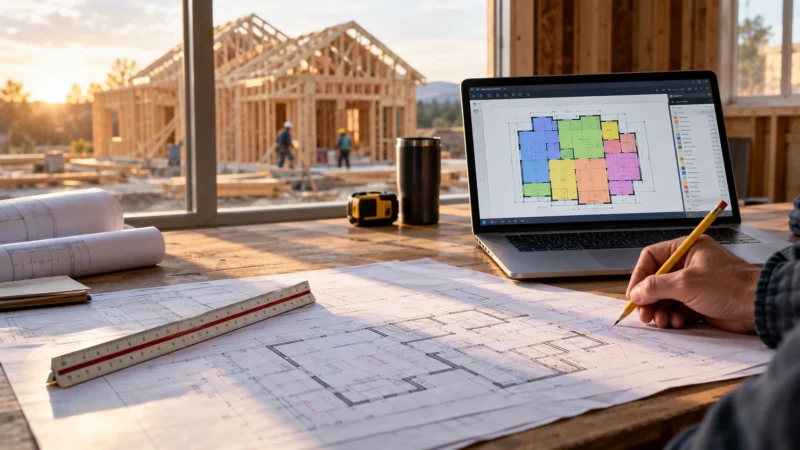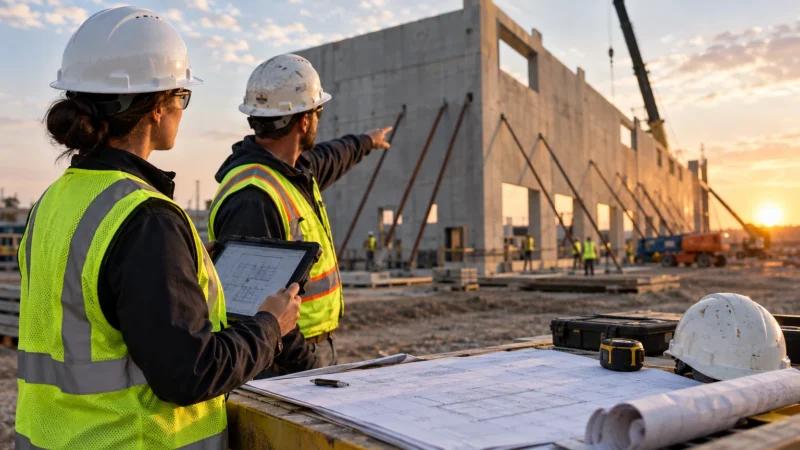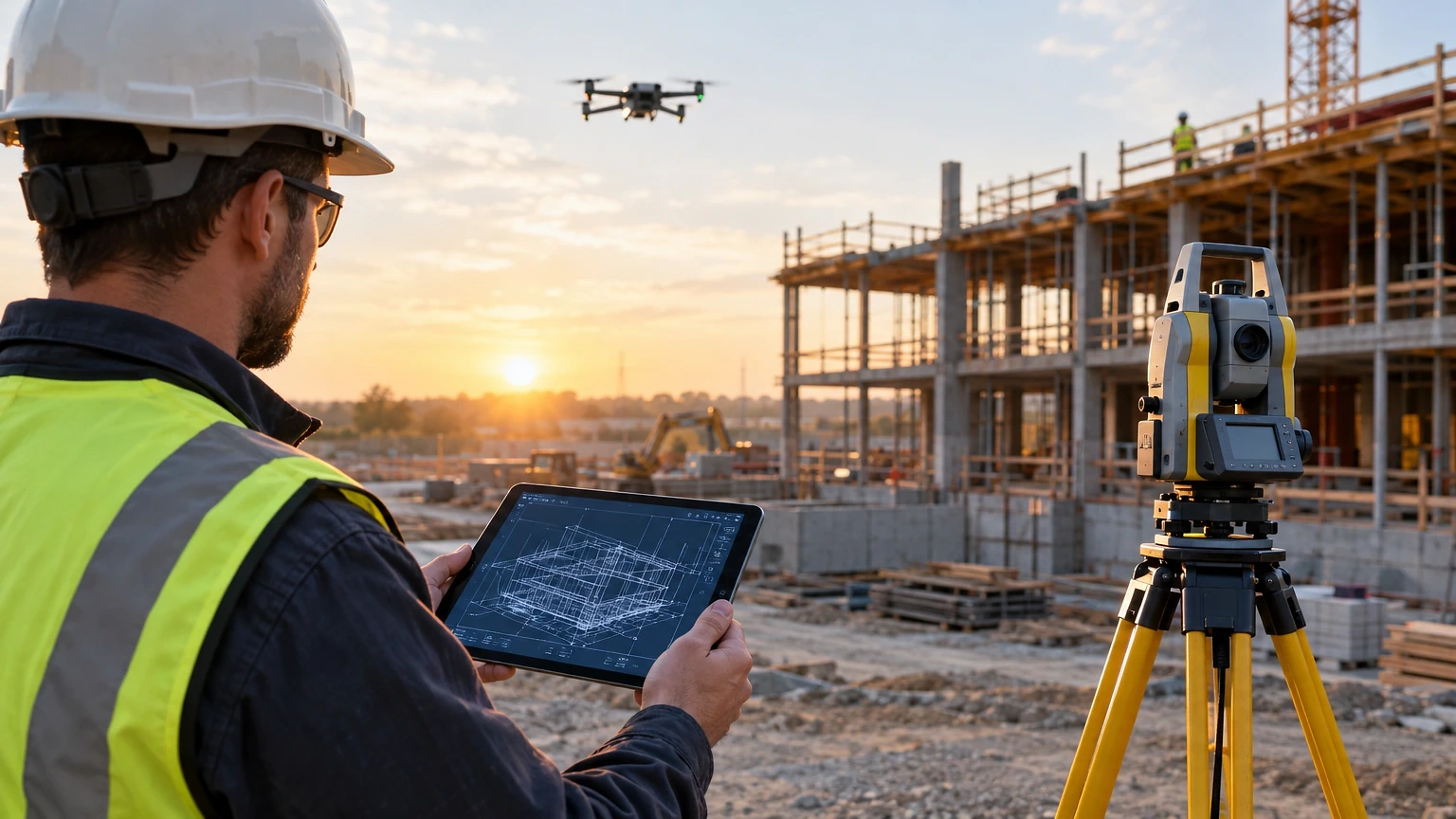
It’s Monday, and your super is texting photos of a wall that doesn’t match the latest drawing. Meanwhile, three people have three different PDFs open. Somebody framed to Rev 4, and Rev 6 has been out for a week. That mess is behind a simple question: what is construction technology, and what does it actually fix on your jobs?
Construction technology is any software, hardware, or data tool that helps you plan, build, and manage a project with less rework and less guessing. In addition, it covers everything from cloud project management to drones and robotic total stations. The point is not novelty. The point is fewer surprises on site.
Definition: Construction technology (ConTech)
Software, devices, and digital methods used to estimate, plan, coordinate, build, and document a construction project. Examples: project management platforms, takeoff software, BIM, drones, GPS machine control, and field safety apps.
What Counts as Construction Technology
The label gets stretched, so draw a line. In other words, a tool counts if it changes how information moves between the office and the field, or how work gets measured.
Most tools fall into five buckets:
- Estimating and takeoff software
- Project management and document control
- Modeling and coordination (BIM)
- Field hardware: drones, scanners, robotic total stations, machine control
- Safety and workforce management apps
A shared drawing set on a tablet counts. So does a $60,000 scanner. In the end, what matters is whether the tool fits the job you actually run.
Skip the tools that exist to impress an owner. Instead, pick the ones that fix a leak you can already name, such as lost RFIs or takeoff errors.
Project Management Platforms: Where Most Firms Start
For most general contractors, this is the first real purchase. Specifically, these platforms hold drawings, RFIs, submittals, daily logs, and punch lists in one place.
Take the Monday example. With a platform like Procore, the superintendent opens the current sheet set on a tablet, and the old revision is superseded automatically. Nobody frames to Rev 4 again.
Procore prices on annual construction volume and quotes custom. HammerTech, which focuses on workforce and site safety management, also quotes custom, with a sliding scale by annual construction revenue. As a result, expect a sales call, not a price tag.
Be honest about the weak spots. These platforms are heavy. For example, a five-person crew running $2M a year in remodels may spend more time feeding the system than using it. They also depend on the field staff actually entering data. In short, a platform no one updates is an expensive filing cabinet.
Therefore, ask for a pilot on one live job before you sign an annual contract.
Estimating and Takeoff Technology
This section is for the person doing the takeoff. You already know the pain: measuring slab on grade by hand, re-counting doors, and discovering a missed addendum the day after bid.
Digital takeoff lets you click a plan, set a scale, and get area, linear footage, and counts. Tools like Bluebeam Revu, PlanSwift, and Togal.AI are common here. Furthermore, each pulls quantities from PDFs and feeds them into your cost sheet.
Here is a real bid example. Say you measure 18,000 SF of 6-inch slab on grade. Digitally, you can overlay the addendum sheet and see the change instantly, rather than re-measuring everything. That is where time is saved: revisions, not the first pass.
Where these tools fall short:
- Auto-detect features miss hatched or cluttered plans
- Scale errors carry through every quantity
- They measure what is drawn, not what is missing
Therefore, always spot-check a few quantities by hand. If the software says 18,000 SF and your rough dimension math says 16,500, find out why before you bid.
BIM, Drones, and Reality Capture
These are the tools people picture first, and they are the ones most often oversold.
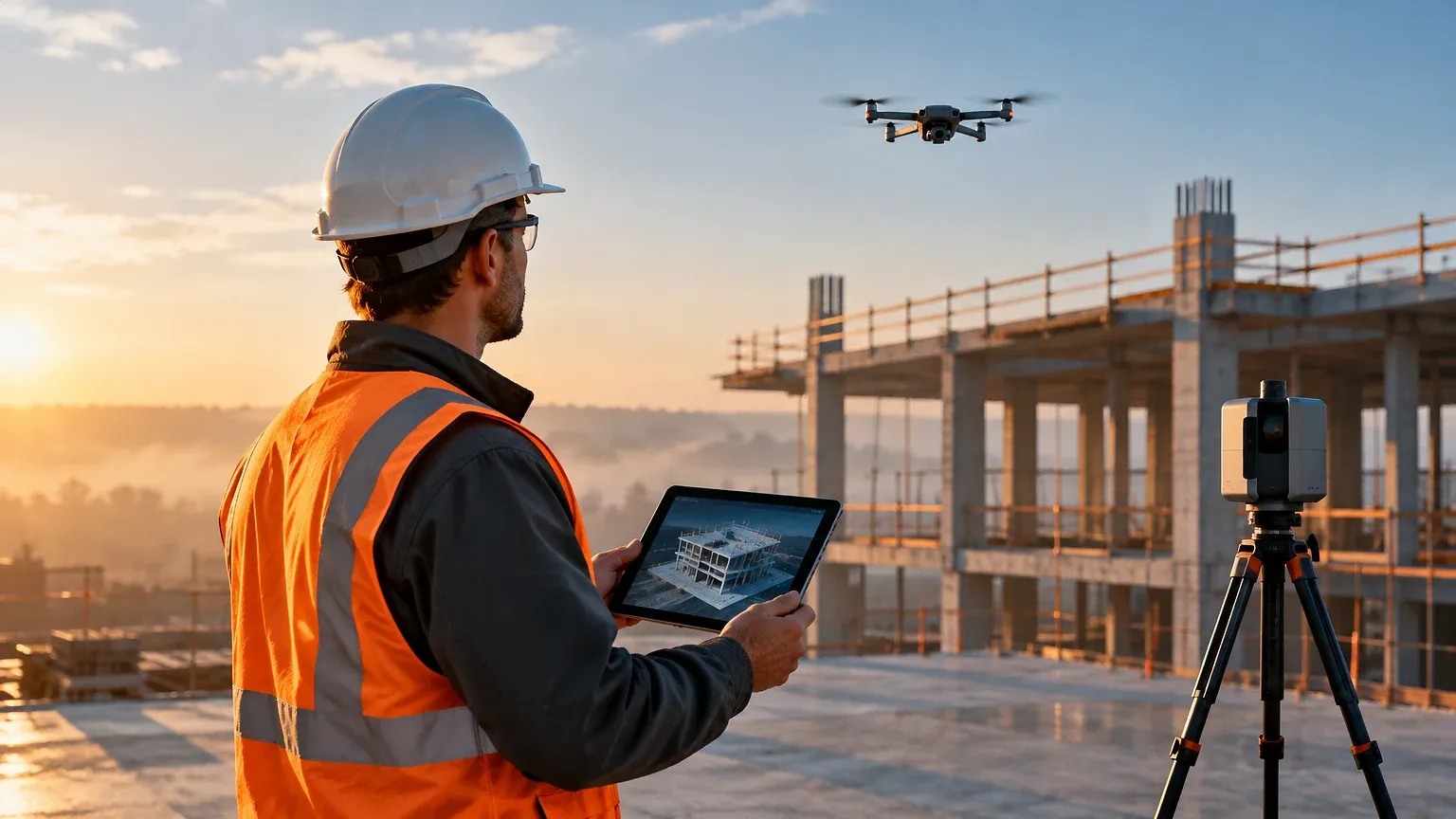
BIM (Building Information Modeling) is a 3D model that carries data. Moreover, its real jobsite value is clash detection: finding that a duct runs through a beam before the sheet metal shop fabricates it. For example, a coordination meeting in Navisworks that catches ten clashes saves field rework that costs far more than the meeting.
Also, drones capture progress photos and earthwork volumes. For instance, a site survey that took a crew two days can be flown in an afternoon. Pair the flight with software like Pix4D or DroneDeploy to turn photos into measurable maps.
Know the limits. Drone use for commercial work in the US generally requires FAA Part 107 certification for the pilot. Therefore, check current rules with the FAA before you fly. Models are also only as good as the drawings behind them, and a model nobody in the field opens is wasted effort.
Do not take a scan or model as an engineering sign-off. Rather, structural questions go to your licensed engineer.
Comparison: Which Tool Fits Which Problem
First, match the tool to the leak. Here is a quick-reference table.
| Tool type | Fixes | Example products | Weak spot |
|---|---|---|---|
| Project management | Lost RFIs, version control | Procore | Heavy setup, needs field buy-in |
| Takeoff software | Slow, error-prone quantities | Bluebeam, PlanSwift | Misses unclear plan details |
| BIM coordination | Field clashes | Navisworks | Needs a disciplined modeler |
| Drones / capture | Progress and volumes | DroneDeploy | Weather, pilot certification |
| Safety / workforce | Site access, compliance records | HammerTech | Needs worker adoption |
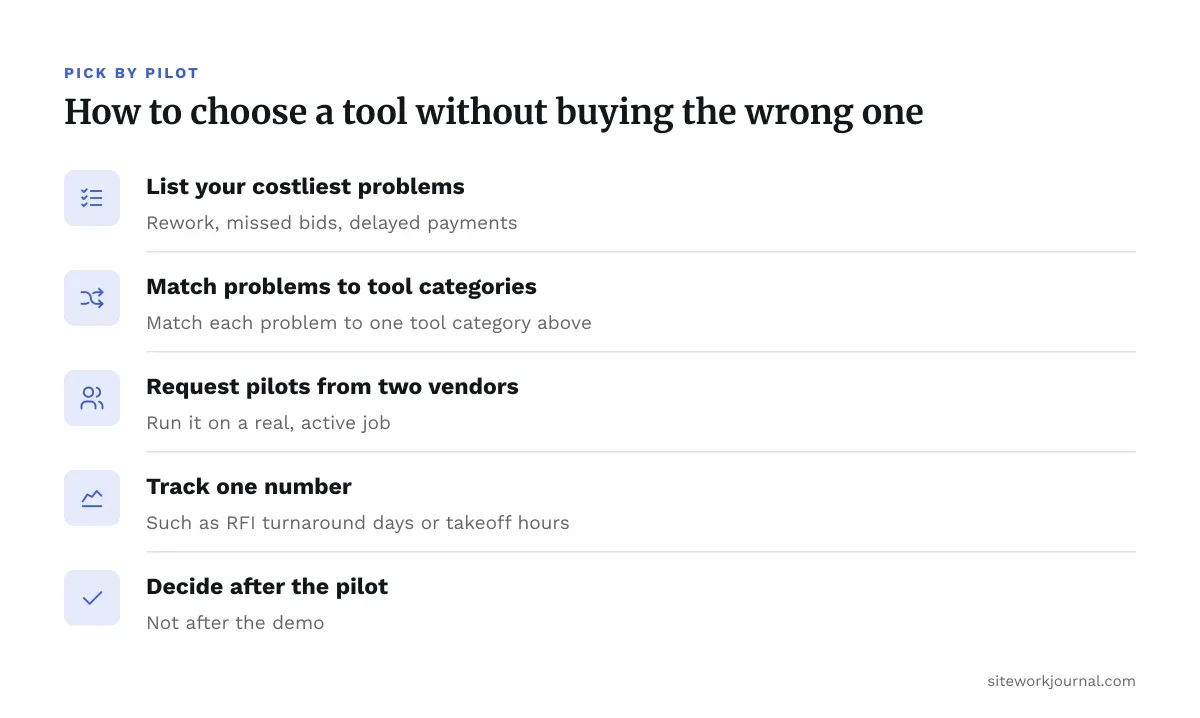
Use these steps to choose what to buy first:
- List your three costliest recurring problems (rework, missed bids, delayed payments).
- Match each problem to one tool category above.
- Ask two vendors for a pilot on a real, active job.
- Track one number during the pilot, such as RFI turnaround days or takeoff hours.
- Decide only after the pilot ends, not after the demo.
For deeper reading on what pays off in practice, see which construction technology earns its keep on a jobsite.
Rolling It Out Without Losing Your Crew
Most failed rollouts die in the field, not in the office. The software works. However, the foreman just never opens it.
Start small and use a checklist like this:
- Pick one project and one tool.
- Name a single owner, usually a project engineer or assistant PM.
- Train the superintendent for 30 minutes on the one task they will do daily.
- Set a rule: if it is not in the system, it did not happen.
- Review usage after two weeks and fix friction before adding anything.
Q: What if the crew refuses to use it?
Then the tool is too complicated or solves nothing for them. Ask the foreman what slows him down and pick the tool that fixes that. Consequently, adoption follows relief, not mandates.
A phone app that takes 20 seconds beats a platform that takes five minutes. Above all, field tech lives or dies on speed.
Final Thoughts: Buy the Fix, Not the Hype
Construction technology is not a single product. In fact, it is a toolkit, and the right pieces depend on where your jobs actually leak time and money. Finally, start with the problem you can name, run a pilot, and measure one number.
If you want a wider view of the market, the latest construction technology news shows what is moving and what is still hype. Keep a skeptical eye on anything that promises to replace judgment.
When a tool touches code compliance, structural decisions, or contract language, bring in the right professional. That means your licensed engineer, the AHJ, or a construction attorney. Software informs those decisions. It does not make them for you.
Frequently asked questions
What is construction technology in simple terms?
It is any digital tool or device that helps you estimate, plan, build, or document a project. That includes software like project management platforms and takeoff tools, plus hardware like drones and scanners. The goal is fewer errors and faster information flow.
Do small contractors need construction technology?
Not all of it. A small remodeler may only need digital takeoff and a shared drawing app. Buy for the problems you have now. Heavy platforms built for large GCs often cost more effort than they return at small scale.
How much does construction technology cost?
It varies widely. Procore and HammerTech both use custom quotes based on volume or revenue, so you must request pricing. Some takeoff and field apps use per-user subscriptions. Always ask for a pilot before committing to an annual contract.
Is BIM required on every project?
No. Some owners and public projects require it in the contract, but most small and mid-size jobs do not. Check your contract documents and the owner’s requirements. If BIM is specified, bring in someone who has run coordination before.
Can software replace an estimator or superintendent?
No. Tools speed up measuring and record keeping, but they do not judge means and methods, sequence trades, or read a site. Treat them as a faster pencil, not a replacement for field experience.