Rework runs about 5% of total project cost on a typical commercial job, according to the Construction Industry Institute. Most of the construction technology examples below target exactly that leak.
Not every tool deserves a login. I’ve sorted these by where they save money: preconstruction, field coordination, safety, equipment, and closeout.
Construction Technology Examples: Quick Picks by Job Type
Start with the problem, not the product.
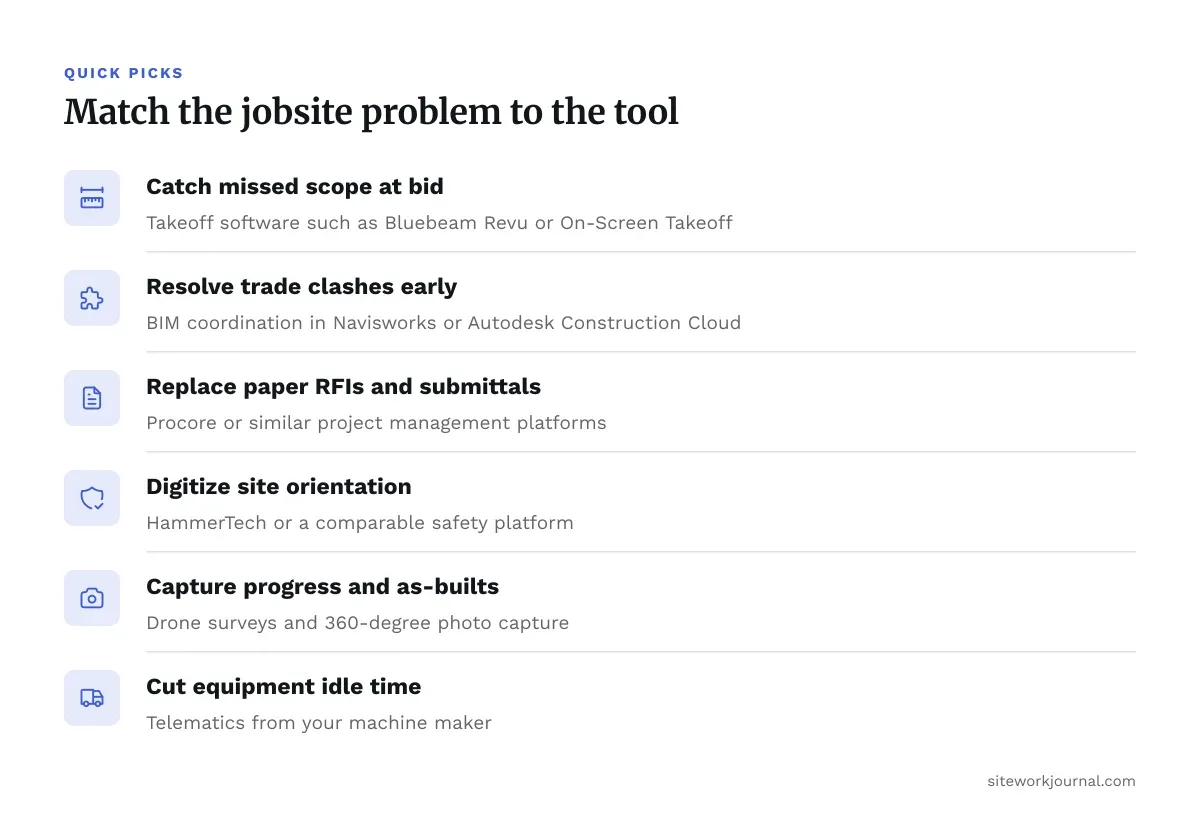
- Missed scope at bid time: takeoff software such as Bluebeam Revu or On-Screen Takeoff.
- Clashes between trades: BIM coordination in Navisworks or Autodesk Construction Cloud.
- Paper RFIs and submittals: Procore or similar project management platforms.
- Site orientation and compliance: HammerTech or a comparable safety platform.
- Progress and as-built records: drone surveys and 360-degree photo capture.
- Equipment idle time: telematics from your machine maker.
Pick one from this list and run it on a single job. If it doesn’t survive a month in the field, drop it.
Construction Technology Examples for Takeoff and Estimating
A paper takeoff on a 40,000 square foot tilt-up warehouse can eat two days. Digital takeoff cuts the counting, not the judgment.
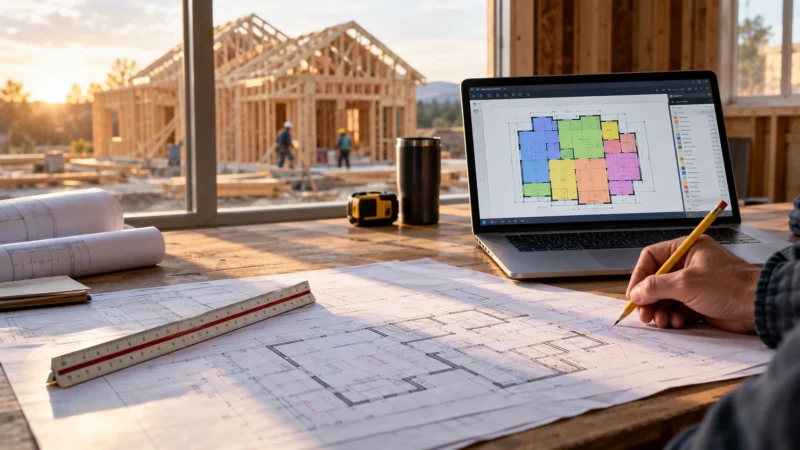
You upload the plan set, set the scale, and click or trace each item. Concrete SF, wall LF, door counts, and ceiling area all roll into a quantity sheet. Bluebeam handles PDF markup and measurement well. Dedicated takeoff tools connect quantities straight to assembly pricing.
The weakness is scale errors. A sheet printed at the wrong scale, or a drawing set with mixed scales, gives you confident wrong numbers. Verify one known dimension per sheet before you trust the rest.
Run a sanity check against a historical cost per square foot. If your total lands 15% off your last similar job, find out why before the bid goes out.
BIM Coordination and Clash Detection
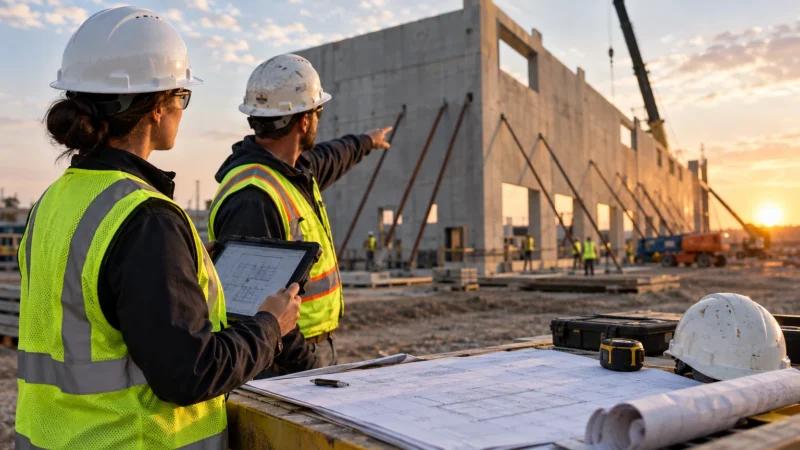
On a three-story medical office, the mechanical sub and the structural steel fabricator both claimed the same ceiling space above the corridor. A coordination model caught it in a weekly meeting. Field discovery would have meant cutting hangers and rerouting duct.
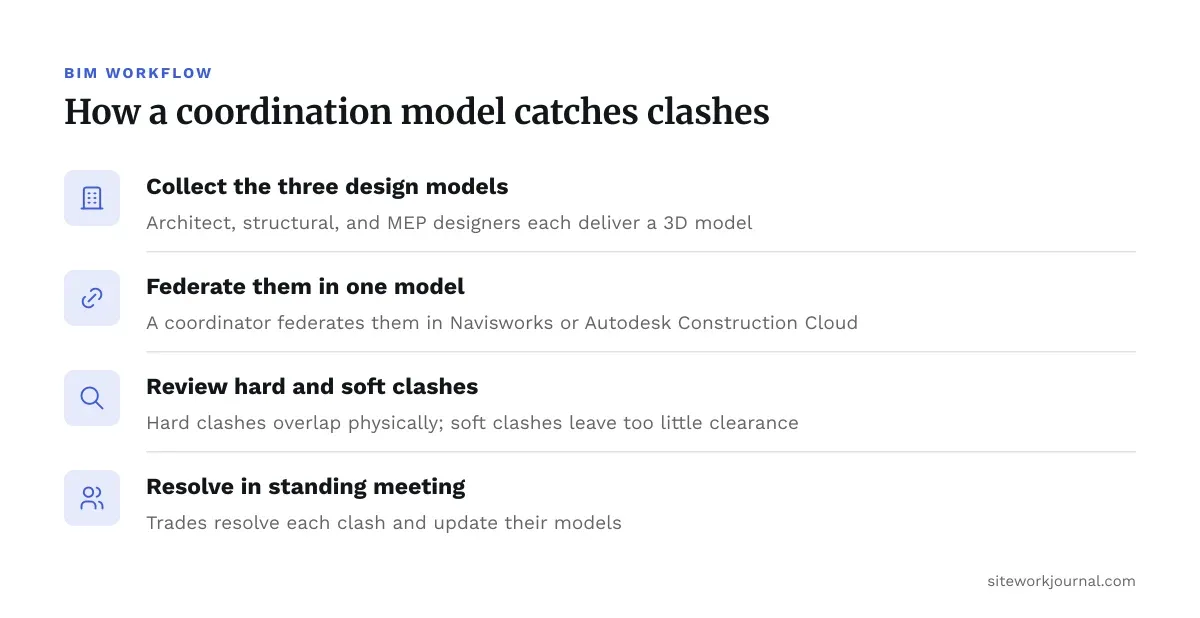
Here is how coordination usually runs:
- The architect, structural, and MEP designers each deliver a 3D model.
- A coordinator federates them in Navisworks or Autodesk Construction Cloud.
- The software flags hard clashes, where objects physically overlap, and soft clashes, where clearance is too tight.
- The trades resolve each one in a standing meeting and update their models.
BIM is bad at small jobs. If your project is a 6,000 square foot tenant improvement, the modeling cost can exceed what it saves. It also depends on trade partners who actually model to usable detail. Ask in the preconstruction meeting who is delivering what level of detail.
Project Management and Field Collaboration Platforms
Procore is the name most people know. It handles RFIs, submittals, daily logs, drawings, and punch lists in one place. Pricing is a custom quote, based on annual construction volume, so you won’t see a number on the website. Expect to negotiate.
What it does well: one current drawing set on every phone, and a time-stamped record of who asked what and when. That record matters when a change order dispute lands.
What it does poorly: it can be heavy for small contractors, and adoption fails if your subs won’t log in. A platform your foremen ignore is a very expensive filing cabinet.
Before you sign, ask for the per-user versus volume-based terms in writing. Confirm what happens to your data if you cancel.
Construction Technology Examples for Jobsite Safety and Compliance
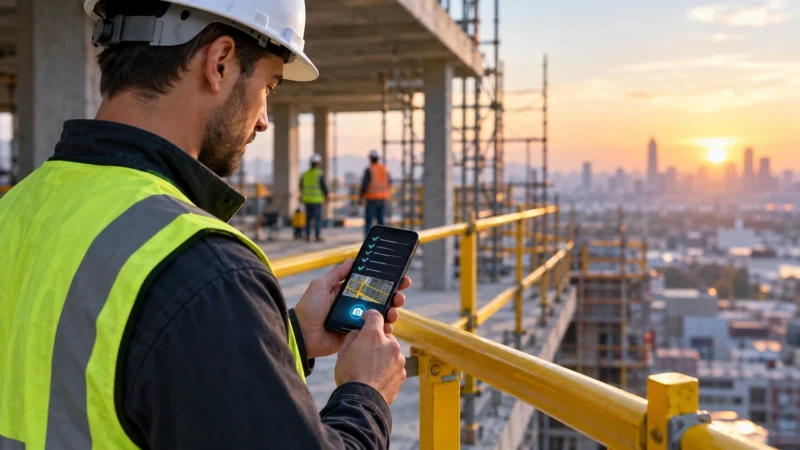
Paper sign-in sheets and binder-based orientations leave gaps. Safety platforms move orientation, credential checks, and incident reporting onto phones and kiosks.
HammerTech sells on custom quotes across Standard, HammerTech GO, and Enterprise plans. The GO tier is priced on a sliding scale by annual construction revenue. That structure favors mid-size contractors who want orientation and induction tracking without a custom build.
The practical gain is verification. Before a sub’s worker badges in, the system can check that their certifications are current. That beats discovering an expired card during an inspection.
Software does not replace a competent person on site. It records and reminds. For OSHA obligations, written programs, or citation responses, talk to your safety director or a qualified safety professional. I’d also keep your insurance carrier in the loop, since many carriers have preferences on documentation.
Drones, Reality Capture, and Equipment Telematics
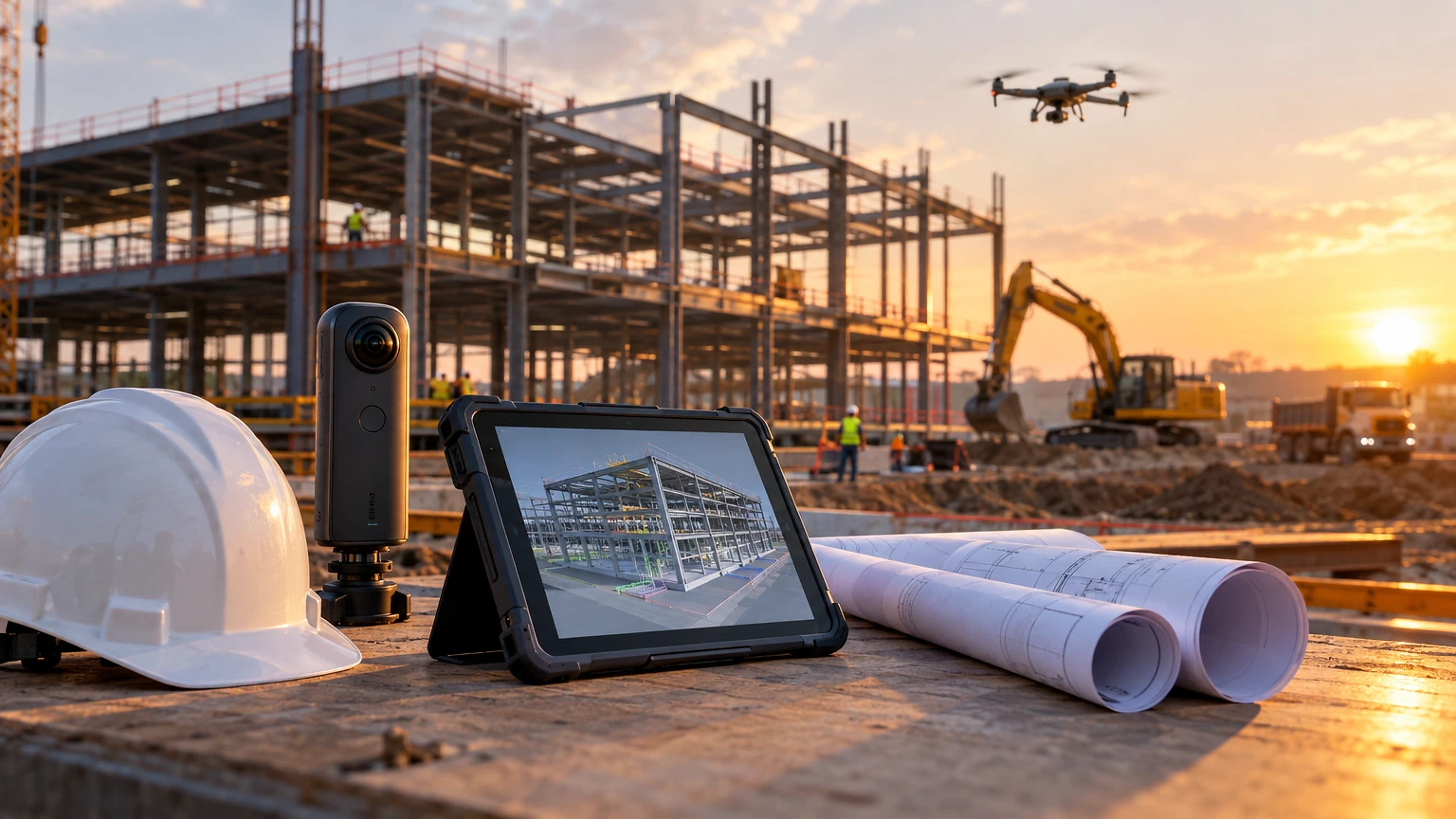
A drone flight over a 12-acre site gives you a stockpile volume in an afternoon. A survey crew with a total station takes longer and costs more per visit. Photogrammetry software turns the images into an orthomosaic and a surface model you can measure.
The limits are real. You need a Part 107 remote pilot certificate from the FAA for commercial flights. Weather, tree cover, and airspace restrictions can ground you. Accuracy without ground control points is not survey grade, so don’t use it for staking.
Telematics is the quieter win. Machine-mounted sensors report engine hours, idle time, and location. If your 20-ton excavator idles 40% of every shift, you are paying for fuel and wear on nothing. Pull the idle report weekly and talk to the operator, not around him.
For any survey that feeds legal boundaries or structural decisions, bring in a licensed surveyor or engineer.
How Do You Compare These Tools Fairly?
Use the same four questions for every vendor.
| Tool Type | Best At | Weak At | Pricing Model |
|---|---|---|---|
| Digital takeoff | Faster, repeatable quantities | Wrong-scale sheets | Per user, subscription |
| BIM coordination | Catching clashes early | Small jobs, low model detail | Per seat or per project |
| Project management | Records, RFIs, drawings | Sub adoption, small-shop cost | Volume-based custom quote |
| Safety platforms | Credential and orientation tracking | Replacing a competent person | Custom quote by revenue |
| Drones and reality capture | Stockpiles, progress photos | Survey-grade accuracy | Hardware plus software |
| Telematics | Idle and utilization data | Needs operator buy-in | Often bundled with machines |
Ask every vendor for a pilot on one live job before a multi-year contract. Price the training time, not just the license.
Choosing and Rolling Out Technology Without Wasting Money
Most failed rollouts die the same way. Someone buys a platform, trains the office, and never trains the field.
Start with one pain point you can measure, like RFI turnaround time or rework hours. Set a baseline before you start. Pick one project and one champion, ideally a superintendent people respect. Give it 60 days, then compare against the baseline.
Read what actually works in the field in our guide to construction technology that pays off on a jobsite. It covers the adoption mistakes in more detail.
Contracts deserve a careful read. Data ownership, auto-renewal clauses, and termination terms vary. Have a construction attorney review anything that binds you for more than a year.
What to Take Away
The best construction technology examples share one trait. They replace a task your crew already does badly or slowly, and they produce a record you can use later.
Start with the pain you can count. Pilot before you commit. Name a field champion, and write down the baseline so you know whether it worked.
For ongoing updates on what’s launching and what’s hype, see construction technology news worth your attention.
Frequently asked questions
What are the most common construction technology examples on a jobsite?
Project management platforms, digital takeoff, BIM coordination, drone surveys, safety software, and equipment telematics. Most contractors adopt in that rough order, starting with whatever stops the most paperwork.
Is construction technology worth it for a small contractor?
Often yes, but start small. A takeoff tool or a basic project management app can pay back on a handful of jobs. Skip heavy BIM or enterprise platforms until your project size justifies them.
How much does construction software cost?
It varies widely. Procore and HammerTech both use custom quotes, so you need to request pricing. Takeoff and field apps often charge per user. Ask for a pilot and read the renewal terms.
Do drones need a license for construction work?
For commercial use in the United States, the pilot needs an FAA Part 107 remote pilot certificate. Check local airspace rules too. Confirm requirements with the FAA before you fly on a paying job.
Can software replace a safety manager or engineer?
No. Software tracks and reminds. Safety program decisions, code questions, and structural calls belong to your safety professional, the AHJ, or a licensed engineer.