Most safety training gets treated like a box to check before the crew hits the deck. That’s backwards. The contractors who stay out of court and keep their mod rate down treat construction safety training as a scheduling line item, same as a concrete pour or a steel delivery.
If your training program is a PowerPoint deck shown once a year, you don’t have a program. You have a liability exposure with a certificate attached.
What Counts As Real Construction Safety Training
Real training means a worker can demonstrate a skill, not just sit through a slideshow. OSHA draws this line clearly in its construction standards under 29 CFR 1926: training has to be specific to the hazards on that job, delivered in a language the worker understands, and documented with dates, topics, and trainer names.
A generic “fall protection awareness” video does not satisfy a site with a 30-foot leading edge and a swing-stage scaffold. Training has to match the actual exposures on that project.
On a steel erection job, that means OSHA 1926 Subpart R content, not Subpart M general fall protection. On a trench job deeper than 5 feet, it means competent person training on protective systems under Subpart P, trench box or shoring specifics, and daily inspection sign-off. Mixing these up is where citations happen. An inspector who finds a trench crew holding only a general 10-hour card, with no documented competent-person designation, writes that up as a serious violation, full stop.
Documentation is the other half. Keep sign-in sheets, topic outlines, and trainer qualifications in the project file, not just in HR’s cabinet across town. When OSHA shows up after an incident, the superintendent needs to produce that paperwork inside the hour, not promise to email it next week.
Building A Construction Safety Training Program That Matches Your Scope
Start with your hazard list, not a generic curriculum. Walk the site plan before mobilization and write down every trade-specific exposure: excavation depth, scaffold height, crane radius, confined space entries, hot work locations.
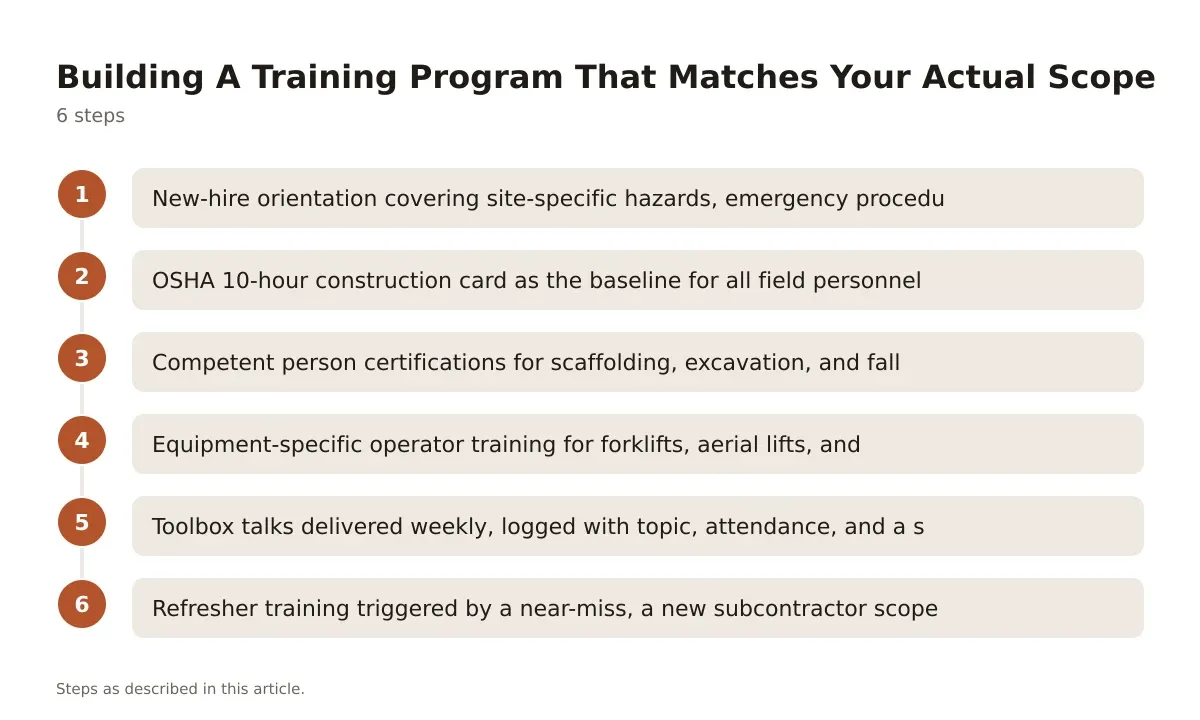
Match each hazard to a required training module. A commercial GC running a mixed crew of steel, concrete, and MEP trades needs a layered program, not a single orientation.
- New-hire orientation covering site-specific hazards, emergency procedures, and PPE requirements, completed before badge issuance.
- OSHA 10-hour construction card as the baseline for all field personnel, OSHA 30-hour for supervisors and foremen.
- Competent person certifications for scaffolding, excavation, and fall protection, renewed per manufacturer or standard-specific intervals.
- Equipment-specific operator training for forklifts, aerial lifts, and cranes, tied to the manufacturer’s model and your site conditions.
- Toolbox talks delivered weekly, logged with topic, attendance, and a short Q&A note from the foreman.
- Refresher training triggered by a near-miss, a new subcontractor scope, or a change in site conditions like a new excavation phase.
That sixth item gets skipped more than any other. A near-miss on a swing-stage job should trigger a same-week retraining session, not a line in the incident log that nobody revisits.
Construction Safety Training Delivery: Field Instructor Vs Online Platform
You’ve got three real options for delivery: in-house trainer-led sessions, a third-party safety consultant, or an online learning management system. Each has a real cost and a real weakness.
In-house trainer-led training, run by your own safety director or a senior superintendent, costs the least per head once you’ve built the curriculum. It runs maybe $0 in direct fees beyond staff time, but it eats four to six hours of a supervisor’s week for prep and delivery. It’s bad at consistency across multiple job sites, because the message drifts depending on who’s teaching it that week.
Third-party safety consultants, firms that come onsite and run OSHA 10/30 classes or competent-person certifications, typically charge a per-person fee for a 10-hour course, with higher rates in union markets like New York or Illinois. They’re strong on documentation and third-party credibility if you land in litigation. They’re weak on site-specific nuance, since they’re often running the same deck for five different GCs that month.
Online LMS platforms like SafetySkills or Vector Solutions run subscription pricing, usually quoted per-seat annually, and let you track completion across multiple projects from one dashboard. They’re convenient for geographically spread crews. They’re bad at hands-on skills: you cannot teach proper trench box placement or fall arrest anchor selection through a video module. Pair any LMS with hands-on field verification, or you’re just generating paper.
Quick-Pick Training Resources Worth Budgeting For
If you’re building or rebuilding a program this year, these are the five resources worth putting a line item against.
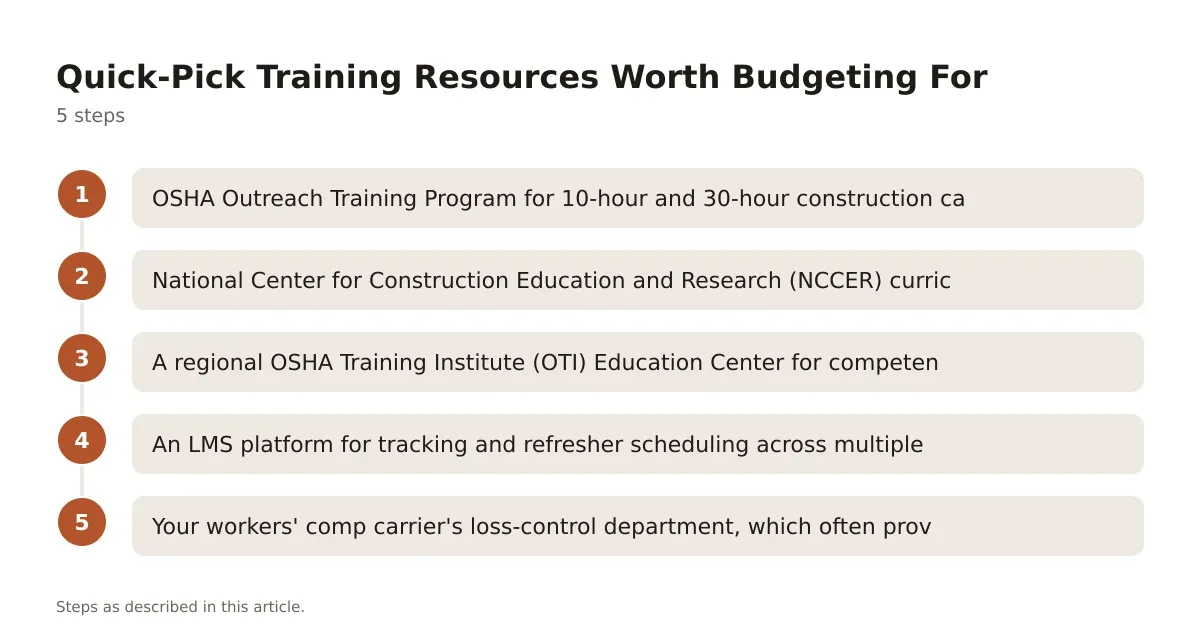
- OSHA Outreach Training Program for 10-hour and 30-hour construction cards, delivered through authorized trainers, the baseline every GC should require.
- National Center for Construction Education and Research (NCCER) curriculum for craft-specific safety modules tied to trade certifications.
- A regional OSHA Training Institute (OTI) Education Center for competent-person courses in excavation, scaffolding, and fall protection.
- An LMS platform for tracking and refresher scheduling across multiple active jobsites.
- Your workers’ comp carrier’s loss-control department, which often provides free site assessments and training materials as part of your policy.
That last one gets ignored constantly. Most comp carriers will send a loss-control rep out for a half-day site walk at no extra charge, and the written recommendations carry weight if a claim gets disputed later.
Scheduling Construction Safety Training Around Production
The pushback you’ll hear from every super is that training eats production hours. It does, a little. The fix is scheduling it like any other critical-path task, not bolting it onto the end of a shift when everyone’s checked out.
Run toolbox talks at the start of shift, 10 to 15 minutes, before tools come out of the gang box. Schedule competent-person recertification during slow weeks, like between a foundation pour and steel delivery, instead of waiting until the certification lapses mid-erection.
On a multi-phase commercial job, build a training matrix into your three-week look-ahead schedule the same way you track submittals or long-lead equipment. If excavation starts in week four, the trench competent-person card needs to be current by week three, not scrambled for on the Monday the backhoe shows up.
Common Questions From Supers Running The Day-To-Day
How often does a worker need refresher training?
There’s no single federal interval for general refreshers, but certain certifications have fixed cycles, like crane operator certification under OSHA’s crane standard, which typically requires renewal every five years through an accredited testing organization. Trigger extra refreshers after a near-miss, a scope change, or a new piece of equipment on site, regardless of the calendar.
Who qualifies as a competent person on a jobsite?
A competent person is someone capable of identifying existing and predictable hazards in the work area and who has authority to take prompt corrective action, per OSHA’s definition. That’s a site-specific determination tied to training and experience, not a credential you buy, so document how and why you designated that person for that scope.
Does an OSHA 10 card satisfy all training requirements on a job?
No. An OSHA 10 card is baseline awareness training, not a substitute for task-specific competent-person training, equipment operator certification, or site orientation. A super who treats the 10-hour card as a complete training record is setting the project up for a citation during a trench or scaffold inspection.
What happens if training records can’t be produced during an inspection?
Missing documentation during an OSHA inspection often turns a borderline citation into a serious one, since the agency reads poor recordkeeping as evidence the program isn’t actually functioning. Keep training files in the site trailer, not just at the home office, so the super can hand them over same-day.
Should a GC require subcontractors to carry their own training records?
Yes, and it belongs in the subcontract language, not a verbal handshake. Require proof of current OSHA cards, competent-person designations, and equipment certifications before that sub’s crew badges onto the site, and spot-check records during your regular safety walks, a practice covered in more depth in construction safety management planning for active jobs.
Training records, like every other piece of your safety program, need to survive an audit, an inspection, and a bad day on site. None of this replaces a licensed engineer’s sign-off on fall protection design, a construction attorney’s review of your subcontract safety clauses, or the authority having jurisdiction’s final word on permit conditions. Build the training calendar, document everything, and bring in the right professional when the hazard or the paperwork gets past what a field training program can cover on its own.