OSHA logged over 170,000 construction injuries across recent reporting years, and most of them happened on sites with no dedicated safety staff at all. A construction safety manager is the person whose full-time job is making sure your crew doesn’t become one of those numbers.
This role sits between the field and the front office. Done right, it catches the fall hazard before the inspector does, not after the OSHA citation lands on your desk.
What a Construction Safety Manager Actually Does Day to Day
A construction safety manager runs the jobsite’s safety program from the ground up. That means writing the site-specific safety plan before mobilization, not after the first near-miss.
Most mornings start with a walk. The manager checks scaffold tags, fall protection anchor points, trench boxes, and fire extinguisher locations before the first trade shows up. On a mid-size commercial job running 40 to 60 workers, that walk takes 45 minutes to an hour if done properly.
Toolbox talks happen daily or weekly depending on the GC’s policy. The manager picks the topic based on what’s active that week: steel erection gets a fall protection talk, excavation gets a competent-person refresher on trench safety under 29 CFR 1926 Subpart P.
Incident investigation is the part nobody likes but everyone needs. A good safety manager documents near-misses with the same rigor as a recordable injury. That paper trail matters when your experience modification rate (EMR) comes up for renewal with your insurance carrier, and a lower EMR directly affects your bid competitiveness on public work.
Required Certifications and Qualifications
Most GCs hiring a safety manager want a specific credential stack, not just “safety experience.”
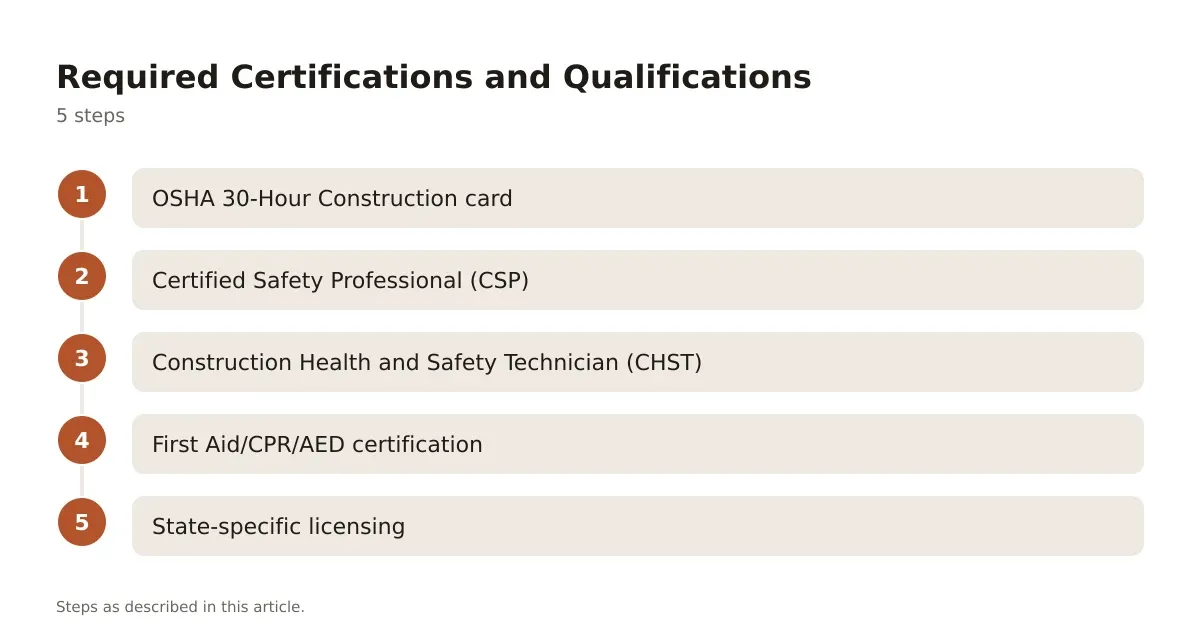
- OSHA 30-Hour Construction card – the baseline. Many states and public owners require this just to be on site in a supervisory role. It’s a classroom or online course through an OSHA-authorized trainer, not a certification exam.
- Certified Safety Professional (CSP) through the Board of Certified Safety Professionals – this is the credential that separates a safety coordinator from a safety manager on a resume. It requires a degree, documented safety experience, and a proctored exam.
- Construction Health and Safety Technician (CHST) – also through BCSP, geared specifically to construction rather than general industry.
- First Aid/CPR/AED certification – current, not expired. Inspectors and owners will ask to see the card.
- State-specific licensing – some states, like Connecticut and Nevada, have their own supervisor certification requirements layered on top of federal OSHA cards. Check with your state labor department before you assume OSHA 30 covers you.
A degree in occupational safety or construction management helps on larger GC rosters, but plenty of working safety managers came up through the trades first. Field credibility matters as much as the paper.
Where Safety Managers Fit on Bigger Projects
On a $2M renovation, the superintendent often wears the safety hat alongside everything else. That stops working once you’re running multiple trades, multiple shifts, or anything over a sizable amount of contract value, where the liability exposure and OSHA recordkeeping burden justify a dedicated position.
Large GCs typically staff one safety manager per project on anything sizable, with a corporate safety director overseeing multiple sites and setting company-wide policy. On a multi-building campus job, you might see a lead safety manager plus one or two site safety coordinators reporting up, especially once you’re past 150-200 workers on site at peak.
Design-build and CM-at-risk contracts increasingly bake safety staffing into the general conditions line item. Owners on public bid work, especially DOT and federal projects, often specify a minimum safety staffing ratio in the contract documents. Read that section of the spec before you bid it, because understaffing safety on a job that requires a dedicated manager is an easy way to get dinged on a post-award compliance audit.
Building the Safety Program: A Field Checklist
Here’s the sequence a safety manager should run through before and during mobilization on a new site.
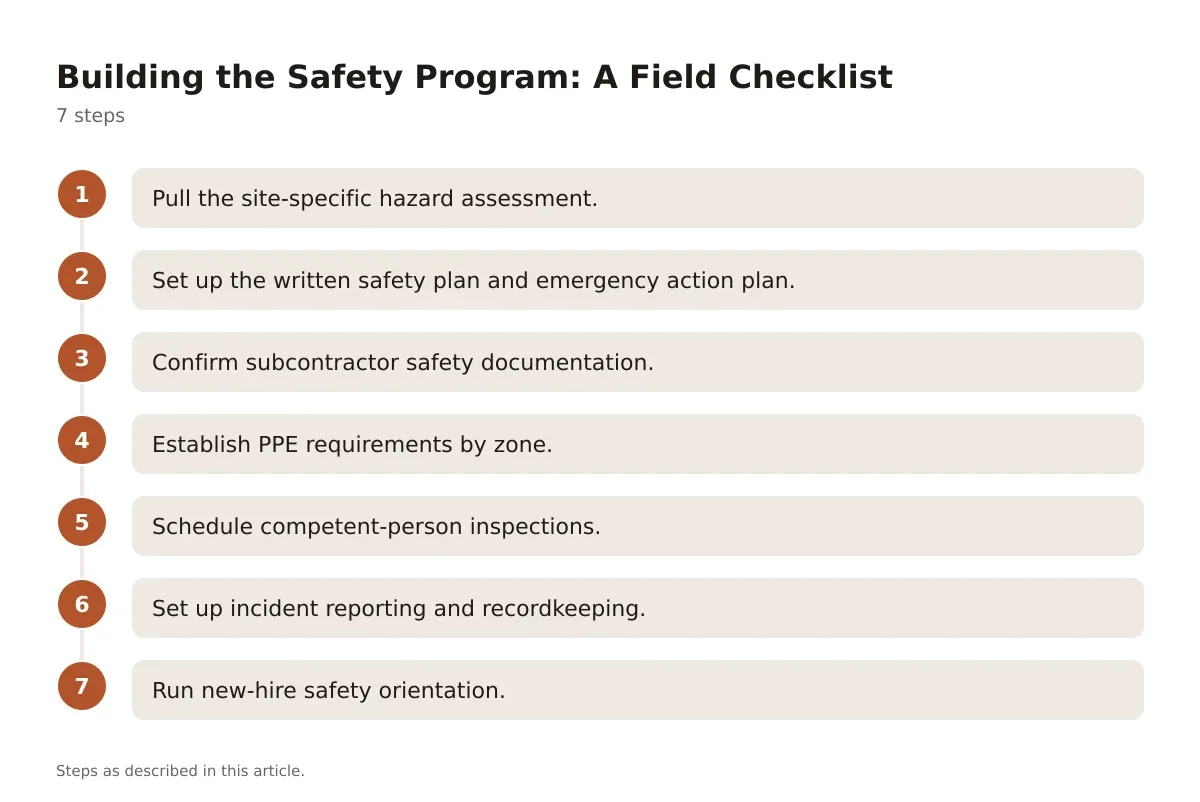
- Pull the site-specific hazard assessment. Walk the site with the project plans in hand and flag excavation, confined space, electrical, and fall hazards specific to the scope – not a generic template.
- Set up the written safety plan and emergency action plan. Include evacuation routes, nearest hospital with trauma designation, and a posted emergency contact list at the gate.
- Confirm subcontractor safety documentation. Collect each sub’s own safety plan, EMR, and OSHA 300 logs before they mobilize equipment.
- Establish PPE requirements by zone. Hard hat and high-vis everywhere, plus task-specific gear – harnesses, respirators, hearing protection – posted at access points.
- Schedule competent-person inspections. Scaffolding, trenching, cranes, and fall protection systems each need a designated competent person under OSHA standards, inspected and logged on a set interval.
- Set up incident reporting and recordkeeping. OSHA 300, 300A, and 301 forms, plus an internal near-miss log that doesn’t get buried in email.
- Run new-hire safety orientation. Every worker, every sub, before boots hit dirt – typically 30 to 45 minutes covering site rules, PPE, and emergency procedures.
Skip step 3 and you’ll find out the hard way when a sub’s crane operator shows up without a current license during a surprise state inspection.
Software and Tools Safety Managers Rely On
Paper checklists still work on small jobs, but anything with multiple subs and shifts needs a digital system that timestamps inspections and stores photo evidence.
Procore handles safety observations, inspections, and incident tracking inside the same platform GCs already use for RFIs and submittals, which cuts down on double entry. Pricing is custom-quoted based on annual construction volume, and the tradeoff is that smaller safety-only shops end up paying for a platform built around the whole project, not just the safety module.
HammerTech is built safety-first rather than safety-as-an-add-on, with stronger subcontractor compliance tracking and credential verification out of the box. It runs on a custom-quoted Standard plan, a revenue-scaled HammerTech GO plan, and an Enterprise tier, all quote-based rather than published flat rates. It’s weaker than Procore on the broader project management side if you need one tool to do everything.
Both platforms generate the audit trail that protects you when an OSHA compliance officer shows up unannounced. For a deeper comparison of what each platform does well and where they fall short on a real job, see this breakdown of construction safety software that actually works on real jobs.
Neither tool replaces a human walking the site. Software logs what the safety manager finds; it doesn’t find it for you.
Why This Role Pays for Itself on the Right Jobs
A dedicated construction safety manager costs real money in payroll. On a job where that cost is justified by scope and risk, it shows up in lower EMR over time, fewer schedule-killing incidents, and cleaner documentation when OSHA or a bonding company comes asking.
The mistake GCs make is treating the role as optional until something goes wrong. By then you’re paying for an incident investigation, possible citations, and a superintendent who’s been pulled off productive work to manage the aftermath. The safety manager’s job is to make that call moot.
If you’re sizing up whether your next project needs one, look at headcount, trade complexity, and what the contract documents require – not just what you did on the last job that happened to go fine.
Common Questions From the Field
Superintendents and PMs ask the same handful of questions when a safety manager position comes up on a new project. Here are the ones that come up most on a bid review call.
Does OSHA require a dedicated safety manager on every job?
No. Federal OSHA doesn’t mandate a specific safety staffing ratio for general construction. Some state plans and specific contract types, particularly federal and DOT work, do set staffing requirements, so check the spec section before assuming.
Who has final authority to stop work?
The safety manager should have stop-work authority written into the project safety plan, co-signed by the superintendent and PM. If that authority isn’t documented, it’s not real authority on a job where schedule pressure is heavy.
How does the safety manager’s role change on a multi-prime job?
Each prime contractor typically runs its own safety program unless the owner designates a single site safety coordinator across all primes – get that structure in writing before mobilization, ideally reviewed by your construction attorney if the contract language is ambiguous.